
You have attended the workshops. You have repeated the affirmations. So why does the old pattern keep firing?
It isn’t a lack of effort. The fact is; words and insight cannot reach the layer where the pattern lives. In this article I’ll show you why, using my Emotional Memory Image (EMI) model, and where Joe Dispenza, Bruce Lipton and Bessel van der Kolk fit into the picture.
Key takeaways
- Affirmations and belief change workshops reach three layers: episodic memory, semantic memory and core beliefs. All three are made of words.
- The Emotional Memory Image sits beneath them. It is pre-verbal, has no story and fires as a non-conscious reflex, so there is nothing for words to rewrite.
- Positive self-statements can backfire when they clash with what the body is already signalling, which is also why the workshop glow fades.
- Dispenza, Lipton and van der Kolk each point to something below language. The EMI names the specific thing to look for.
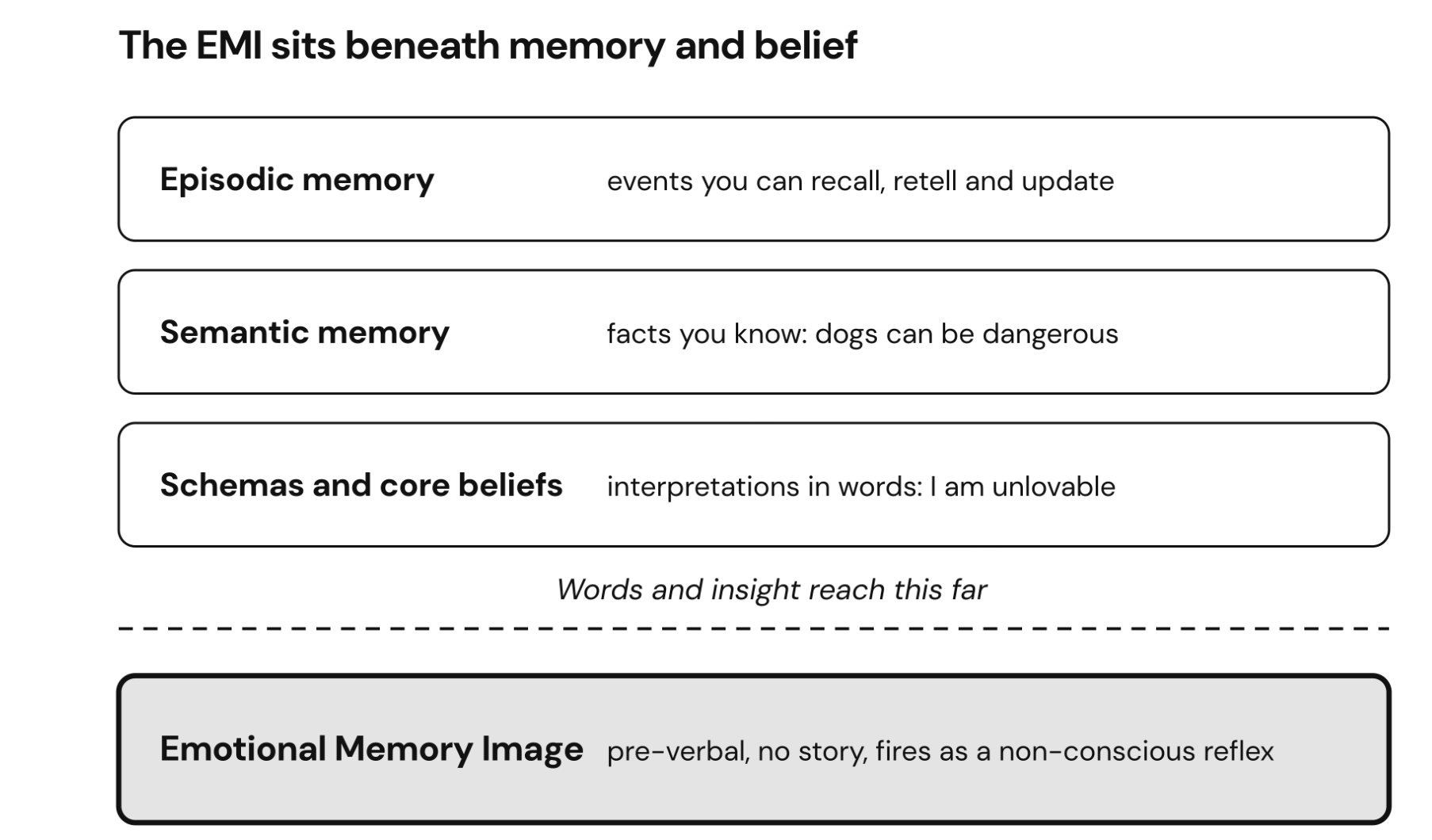
Why belief change workshops and affirmations fail to create lasting transformation
Have you ever stood at the bathroom mirror, said “I am confident, I am worthy, I am enough”… and heard a little voice at the back reply, “No, you’re not”?
You know that voice, don’t you?
Maybe you went further. You booked the weekend, found the limiting belief, tore it up and walked out on Sunday evening ten feet tall. By Wednesday the same knot was back in your stomach.
If that’s your story, cheer up! You didn’t fail. You were handed a very good tool for the wrong floor of the house.
The three layers words can reach: episodic memory, semantic memory and core beliefs
Picture your mind as a house with three floors above ground. Coaching, self-help and talking therapy all work on these floors, and they can do real good there.
Episodic memory: events you can recall, retell and update
The top floor holds the events you can describe. The day the dog bit you. The teacher who laughed at your answer. You can tell the story at a dinner party, and it shifts a little each time you tell it. A story can be edited.
But have you noticed you can retell a memory quite calmly and still feel your body flood with alarm the moment something similar turns up? That is your first clue that the story is not the whole of it.
Semantic memory: the facts you know
The middle floor holds facts. Dogs can be dangerous. “I am worthy.” This is where most affirmations land. Repeat “I am enough” often enough and you will know it, the way you know the capital of France.
Knowing a fact and feeling it in your body are two very different events.
Schemas and core beliefs: interpretations in words
The ground floor holds your interpretations: “I am unlovable.” “People like me don’t get above themselves.” This is the floor a belief change workshop walks you down to, and it feels like the foundations. Finding that sentence can bring tears to your eyes.
What do all three floors have in common? Language. Every one of them can be spoken, written on a flip chart, argued with and reframed.
Where words and insight stop working
Now look at the dashed line under the ground floor in the figure. Words and insight reach this far. And no further.
The belief “I am unlovable” didn’t arrive from nowhere, did it? Something happened to a very small person, long before that person had the vocabulary to describe it. The belief is the sentence they wrote about it years later.
The belief is the caption. It is not the photograph. You can cross out “I am unlovable” and write “I am deeply loved” in gold ink, and the photograph underneath hasn’t changed… and it is the photograph your body responds to.

What is the Emotional Memory Image (EMI)?
Beneath the line sits what I call the Emotional Memory Image. In my 2021 paper in Frontiers in Psychology, written with Professor Mark Johnson, I proposed it as an image laid down in a moment of overwhelm, held below conscious, and fired again whenever something in the present resembles it. It is a theory, and I offer it as one. It is also the most useful map I have found in my clinic.
Why the EMI is pre-verbal and has no story to rewrite
The EMI was captured by a nervous system, not narrated by a storyteller. There are no words in it, so there is nothing for words to get hold of.
You cannot “think of the time when” either, because it was never filed as a time when. Ask someone to recall their EMI and they will hand you something from the top floor instead: a memory they can reach, which is precisely why it isn’t the one doing the damage.
How the EMI fires as a non-conscious reflex
How fast does it fire? Faster than thought. Your heart is racing and your shoulders are round your ears before the thinking part of you has been told there’s a meeting.
Think of a smoke alarm wired to a photograph. Every time life holds up something that looks a bit like that photograph, the alarm goes off. There hasn’t been a fire for thirty years. But your Unconscious Mind, that loyal guard dog, isn’t interested in the date. It is interested in keeping you alive.
That’s not a fault in you. That’s protection, working exactly as designed, on out-of-date information.
How an EMI forms in a split second
Most learning takes practice. You didn’t ride a bicycle on the first go. But some learning needs only one lesson. Touch a hot stove once and you never need a second lecture.
An EMI is that kind of learning. A raised hand, a slammed door, a look of disgust on a face you depended on… and in a split second a small nervous system takes a snapshot and files it under “never again.” Nobody chose it. Nobody rehearsed it. And because it was learned in an instant, without words, no amount of slow, wordy practice afterwards touches it.
The hopeful part? What was learned in a split second does not need years to unlearn. That is why I call the work Split-Second Unlearning.
From stress to dis-ease: what happens when the alarm never switches off
I spell it dis-ease on purpose. Long before anything has a name or a diagnosis, there is a whole system ill at ease.
Think about what a false alarm costs. Each time the image fires, your body prepares for a threat that isn’t there: the breath shortens, the muscles tighten, the gut clenches. Once is nothing. Several times a day for thirty years is a great deal of bracing.

My theory, and I hold it as a theory, is that this is the road by which unresolved trauma finds its way into the body. So if you carry symptoms that tests struggle to explain, please keep working with your doctor, and consider a second question alongside theirs: what might my body still be responding to?
Why positive affirmations fail and can backfire
So what happens when you stand at the mirror and say “I am calm, I am safe, I am loved”?
You are shouting good news down the stairs to a floor that doesn’t speak English.
The top three floors hear you perfectly. They may even agree. But the EMI goes on firing, and now two messages are running at once: the words say “safe” and the stomach says “danger.” Which one do you believe? The body wins, because it got there first.
What the research on positive self-statements shows
In 2009, Joanne Wood and colleagues published “Positive Self-Statements: Power for Some, Peril for Others” in Psychological Science. People with low self-esteem who repeated “I am a lovable person” ended up feeling worse than those who didn’t. The people who needed the affirmation most were the ones it hurt.
Why? The researchers’ explanation is that a statement too far from how you see yourself gets rejected. My reading goes one floor lower: every repetition holds the caption up against the photograph, and the mismatch is felt in the body. Then, cruellest of all, you blame yourself for not doing it properly.
Affirmations aren’t useless. For someone with nothing firing in the basement they can be a lovely top-up. For a person carrying an EMI, they are a fresh coat of paint on a wall with rising damp. I cover the practical side in why affirmations don’t work, and what does.
Why belief change workshops wear off
Belief change workshops go one floor deeper than affirmations, and I have a lot of respect for the people who run them well. In the room, surrounded by warm, like-minded people, the new belief feels true.
So why doesn’t it last?
Because insight is a top-three-floors event. You understood something. You did not un-fire something. You have gone home with a beautifully rewritten ground floor sitting on the same basement, and the first time your boss raises an eyebrow, the alarm sounds exactly as it did before.
And then… the old belief comes back. Not because you’re weak, but because the belief was never the cause. It was the explanation. Your mind looked at a body in alarm, asked “Why do I feel like this?” and the best answer it could find was “I must be unlovable.” Remove the explanation while the alarm is still ringing and the mind will simply write it out again.
You have been knocking on the front door when the EMI is round the back.
Signs your personal development work has hit the dashed line
How do you know you’ve reached the limit of what words can do? You will recognise yourself in some of these:
- You can explain your trigger perfectly and still be hijacked by it.
- You feel calm in the session and reactive at the kitchen table.
- You collect insights the way other people collect books.
- The reaction arrives before the thought, every time.
- Each new method works for about three weeks.
None of that is a character flaw. It is simply evidence that the work needs to move down a floor.
Why trying harder makes it worse
When a method fails, what do most of us do? More of it. Longer affirmations. A bigger workshop. A stricter morning routine.
Your Unconscious Mind sees all that effort as a push towards the very thing it is guarding you from, so it pushes back. You call it self-sabotage. I call it the Saboteur Within doing its job. It is not your enemy; it is a bodyguard still working from an old photograph. Fight it and it digs in. Show it the photograph is out of date and it can stand down.

What Joe Dispenza, Bruce Lipton and Bessel van der Kolk get right
I am not the first to say a new thought isn’t enough. Three people have done more than most to bring that message to the world, and each of them is pointing below the dashed line.
Joe Dispenza: why the body must agree with the mind
In Breaking the Habit of Being Yourself, Joe Dispenza teaches that thoughts and feelings have to line up before anything changes. The body rehearses a familiar emotional state until it runs on its own. If your shoulders brace while you repeat an affirmation, the body is voting no.
He is right. My question is one step further on: what, exactly, is the body agreeing with? I’d say an image it is still looking at.
Bruce Lipton: subconscious programming and The Biology of Belief
Bruce Lipton’s message in The Biology of Belief is that the conscious mind runs around five per cent of your day, and programmes laid down in early childhood run the rest. He is clear that the subconscious doesn’t learn the way the conscious mind does, which is why saying a new belief once, or a hundred times, rarely rewrites it. (Unity interview)
Lipton places the interface at the cell membrane. In my 2022 paper I propose taking that outward, to the space around the body and the peripersonal space in front of you. That is a hypothesis, not settled science, but it is why I ask clients where a feeling is rather than what it is.
Bessel van der Kolk: The Body Keeps the Score and the limits of talk
Bessel van der Kolk has spent a career showing that trauma is not mainly a story about what happened. Its impact lands on the survival part of the brain and in how a person senses their own body, which is why he looks beyond talking to body-based work. (Psychotherapy.net interview)
If the imprint has no narrative, then something pre-verbal that fires as a reflex is exactly what his work would lead you to expect.
The layer beneath all three: the Emotional Memory Image
Dispenza shows the body must agree. Lipton shows the programme runs below conscious. Van der Kolk shows the body keeps the score. I stand on all three sets of shoulders, and what I add is a specific target: one image, in one place, that the reflex is answering to. When you can find it, you have something to work with.
How to reach the EMI: where to start
Imagine a client. Let’s call her Helen. She isn’t a real person, but her story shows how this work goes.
Helen arrives with a folder. Fifteen years of courses, certificates and journals. “I’ll be honest,” she says, “I know exactly what my limiting beliefs are. I could teach the workshop. And I still can’t speak up in a meeting without my throat closing.”
“That’s fine,” I say. “You don’t need to tell me any of it. Just notice that tightness in your throat. If that feeling were out there in front of you, rather than in here… where would it be?”
She starts to say she doesn’t know what I mean, but her eyes have already gone up and to the left, and her hand follows them.
“There. About an arm’s length away. A face. I’m not sure whose.”
We don’t dig. We don’t ask whose face, or what it said. We work with where the image is and what it looks like, and a few minutes later she takes a breath that seems to go all the way to her shoes.
“It’s gone,” she says. “It’s just… not there. But I never told you anything.”
“You didn’t have to. Your body did the talking.”
Three weeks later she rings. She has chaired the Monday meeting. “I kept waiting for my throat to go, and it didn’t bother turning up.”
A simple exercise: where is the feeling in the space around you?
Try this now. Think of a situation that reliably sets you off, something small, a three out of ten. Notice where you feel it in your body. Then ask: if this feeling were out there rather than in here, where would it be? Up? Down? Close? Far away?
Don’t do anything with it yet. Just look. If you find yourself puzzled, well done, that’s right, you are doing it beautifully. You have just stepped below the dashed line without a single affirmation.
Remembering to forget: why an old image can change
Is it really possible for something that old to shift? Memory research gives good reason to think so.
For most of the last century, scientists assumed a memory was fixed once it had set, like concrete. Work on memory reconsolidation, beginning with Karim Nader and Joseph LeDoux’s laboratory studies in 2000, suggested otherwise: when a memory is brought back to life, it becomes changeable for a short while before it settles again.
I call this remembering to forget. You don’t have to relive the event or even know what it was. The image only has to be found, there in the space in front of you, for the door to open. That is what the where question is for.
How the MindReset app helps
This is the work I built MindReset to support. It is on Apple and Google, and it guides you through locating and clearing these images in your own time.
One gentle word of care. Your symptoms are real and they are physical, so keep seeing your doctor. If what you’re carrying is heavy, do this alongside a trauma-informed practitioner rather than alone.
Frequently asked questions
Why don’t affirmations work for me?
Because they speak to the three floors made of words, and the thing driving your reaction sits beneath them. When you say “I am safe” while your body is braced, the body’s message wins. That isn’t a failure of discipline. The tool was aimed at the wrong layer.
Is an Emotional Memory Image the same as a limiting belief?
No. A limiting belief is a sentence, such as “I’m not good enough.” The EMI is the pre-verbal image the sentence was written about. Change the sentence and the image can still fire. Clear the image and, in my experience, the sentence often has nothing left to explain.
Can I use affirmations alongside EMI work?
Yes, and the order matters. Work with the image first. Once the alarm has stopped ringing, a kind word to yourself has somewhere to land.
How do I know if I have an Emotional Memory Image?
Look for a reaction that is faster, bigger or older than the situation deserves. If a raised eyebrow can ruin your afternoon, something other than the eyebrow is being answered.
Do I need to remember what happened to me?
No. The EMI is below conscious, so it isn’t something you can recall on demand, and you don’t need to. The work is done with where the image is and what it looks like, not with the story of how it got there.
Does this replace therapy or medical care?
No. It sits alongside them. Keep the people who are already looking after you, and treat this as one more floor of the house to explore.
You were never the problem
If the workshops and affirmations haven’t given you the transformation you were promised, please hear this: you are not broken, blocked or beyond help. You have been doing excellent work on three floors of a four-floor house.
The question was never “What’s wrong with me?” It was always “What happened to me?” What your body has been telling you all these years is a message, not a life sentence.
The door is round the back. Shall we go and have a look?
References
- Hudson, M. & Johnson, M. I. (2021). Split-Second Unlearning: Developing a Theory of Psychophysiological Dis-ease. Frontiers in Psychology, 12, 716535. https://doi.org/10.3389/fpsyg.2021.716535
- Hudson, M. & Johnson, M. I. (2022). Definition and attributes of the emotional memory images underlying psychophysiological dis-ease. Frontiers in Psychology, 13, 947952. https://doi.org/10.3389/fpsyg.2022.947952
- Wood, J. V., Perunovic, W. Q. E. & Lee, J. W. (2009). Positive Self-Statements: Power for Some, Peril for Others. Psychological Science, 20(7), 860-866.
- Dispenza, J. (2012). Breaking the Habit of Being Yourself. Hay House.
- Lipton, B. H. (2005). The Biology of Belief.
- van der Kolk, B. (2014). The Body Keeps the Score. Viking.
- Nader, K., Schafe, G. E. & LeDoux, J. E. (2000). Fear memories require protein synthesis in the amygdala for reconsolidation after retrieval. Nature, 406, 722-726.