
Blog 3 of 5 · From the Cell to the Person
“Problems are not the problem; coping is the problem.”
Attributed to Virginia Satir
Have you ever had a smoke alarm go off while you were simply making toast?
There’s no fire. You know there’s no fire. You can see the toast; it’s barely golden! And still the alarm screams as though the house is burning down.
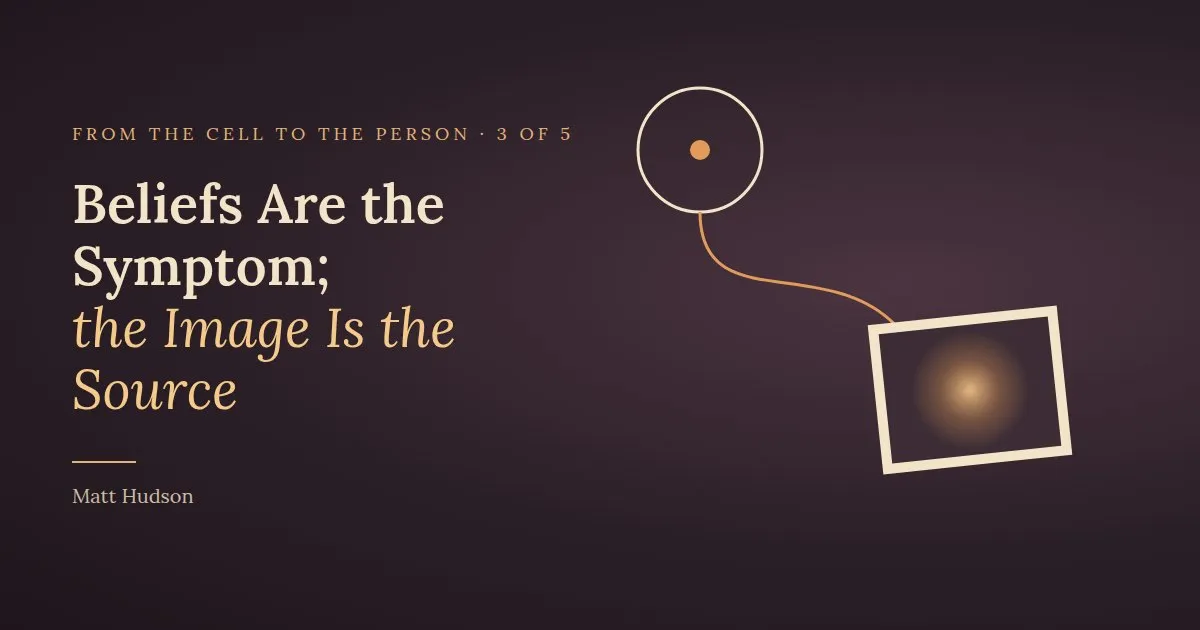
Now imagine that alarm isn’t wired to the smoke at all. Imagine it’s wired to a photograph of a fire, one taken years ago and pinned somewhere you can’t see. Every time something in your life even slightly resembles that photograph, off it goes.

That, in a nutshell, is how I see most of the beliefs that hold people back.
Beliefs don’t come from nowhere
Bruce Lipton’s work showed us how powerfully belief shapes biology. Change what the cell perceives and you change how it behaves. Beautiful. But it leaves a question hanging, doesn’t it?
Where did the belief come from in the first place?
Nobody sits down at the age of five and decides, “I think I’ll believe I’m not good enough.” Beliefs aren’t chosen; they’re concluded. Something happened (often something small, something an adult wouldn’t even notice) and a young mind drew a conclusion to keep itself safe. In my book Family Rules I describe these as below-conscious survival programmes, handed down and absorbed without a single word being spoken.
The conclusion became a belief. And the belief has been held in place, ever since, by an image.
The Emotional Memory Image
I call this image an Emotional Memory Image, or EMI. It’s not a memory you can call up on demand. It’s below conscious; that’s precisely why “think of a time when…” never quite finds it. But your body knows exactly where it is.
In my published work I’ve proposed that these images aren’t tucked away inside your head at all. Following the biologist Donald Forsdyke, who argued that memory may be stored outside the brain, and extending Lipton’s idea of the cell membrane outward, I suggest they’re held in the field around you, in the space just in front of you that neuroscientists call peripersonal space.
So the belief is the alarm. The image is the photograph it’s wired to. And you can reset an alarm as often as you like; while that photograph stays pinned up, it’ll go off again tomorrow.
Why changing the image changes the belief
Here’s the good news, and it’s very good news indeed.
Since the year 2000, neuroscience has been exploring something called memory reconsolidation. Researchers such as Karim Nader and Joseph LeDoux found that when an emotional memory is reactivated, it becomes changeable for a short window before it’s stored again. In other words, memories aren’t carved in stone. They’re more like clay that softens every time you pick it up.
I like to call this remembering to forget. When we find the image and gently change its qualities (where it is, how close, how big, how bright), the memory is stored again in its new form. The facts of your history don’t change. But the emotional charge, the alarm, simply doesn’t fire anymore.
And when the alarm stops, what happens to the belief? It has nothing left to protect you from. It quietly lets go.
Daniel’s “I’m a burden”
Daniel came to see me with a belief he’d carried for as long as he could remember: “I’m a burden.” He wouldn’t ask for help at work. He apologised for everything. He’d had years of talking about it and understood it perfectly. “I know where it comes from,” he said. “Knowing doesn’t help.”
(Names and details changed, as always.)
“That’s fine,” I said. “Let’s not go looking for where it comes from. Let’s look for where it is.”
I asked him to notice the feeling that came with “I’m a burden.” He said it was a weight across his shoulders. “If that weight were out there in front of you, where would it be?”
He pointed above his head, slightly behind. “It’s grey. Heavy. Like a cloud that won’t move.”
We worked with that cloud: its distance, its colour, its weight. After a while Daniel laughed, quite unexpectedly, and said, “It’s floated off. I can’t find it.” His shoulders were visibly lower.
Two months later he told me he’d asked his manager for support on a project for the first time in eleven years. “And I didn’t apologise once,” he said.
We never argued with the belief. We cleared what it was standing on.
So where do you start?
Think of a belief about yourself that you know isn’t fair but still feel is true. Notice the feeling that comes with it. Now ask yourself: if that feeling were out there, where would it be?
Just notice. Is it close or far? Light or dark? Moving or still? That’s the photograph the alarm is wired to.
The MindReset app on Apple and Google guides you through working with images like this, gently and at your own pace. If anything you find feels overwhelming, please work with a trauma-informed practitioner alongside it.
Your beliefs aren’t a life sentence. They’re messages, left by a younger you who was doing the very best they could. Once you clear the picture, you can finally read the message, thank it, and let it go.
The From the Cell to the Person series
Up next: Blog 4: Healing Without the Story →
- Blog 1: Lipton Explained Why. Here’s How.
- Blog 2: Why Affirmations Don’t Work (And What Does)
- Blog 3: Beliefs Are the Symptom; the Image Is the Source (you are here)
- Blog 4: Healing Without the Story
- Blog 5: Your Survival System Did Its Job Too Well
References
- Nader, K., Schafe, G. E., & LeDoux, J. E. (2000). Fear memories require protein synthesis in the amygdala for reconsolidation after retrieval. Nature, 406, 722–726.
- Forsdyke, D. R. (2009). Journal of Theoretical Biology. https://doi.org/10.1016/j.jtbi.2009.01.028
- Hudson, M. (2021). Frontiers in Psychology. https://doi.org/10.3389/fpsyg.2021.716535
- Hudson, M. (2022). Frontiers in Psychology. https://doi.org/10.3389/fpsyg.2022.947952
- Lipton, B. H. (2005). The Biology of Belief. Mountain of Love/Elite Books.