
Blog 1 of 5 · From the Cell to the Person
“Thought defines who you are today and can sabotage who you could be tomorrow.”
Matt Hudson
Have you ever read a book that changed the way you saw yourself… and then closed it, put it back on the shelf, and carried on exactly as before?
If you’ve read Bruce Lipton’s The Biology of Belief, I suspect you know that feeling. I certainly do. It’s a remarkable book. It took an idea many of us felt in our bones (that what we believe shapes our bodies) and gave it a scientific home. And yet so many people I meet in my clinic say the same thing to me: “I understand it all, Matt. I just can’t seem to change it.”
Why? That’s the question this series is about. Lipton explained why our beliefs shape our biology. Over the next five posts, I want to show you how to clear what sits underneath those beliefs, gently, safely, and without having to relive your past.
Just so we’re clear from the start: I’m not connected to Dr Lipton, and he hasn’t endorsed my work. I simply admire his, and I believe the two pieces fit together beautifully.
What Lipton saw at the level of the cell
Lipton spent years as a cell biologist and medical school lecturer, and his big insight was this; the cell isn’t run by its genes alone. It’s run by how it reads its environment. The signals arrive at the cell membrane, and the membrane decides how the cell responds. He playfully called it the “mem-brain,” the cell’s brain.
Change the environment, and you change the behaviour of the cell. Change what the cell perceives, and you change its biology. That was a liberating message for millions of people who’d been told their health was written in their genes, full stop.

What I see at the level of the person
Now, here’s where my own work begins. If the membrane is where the cell meets its world, where does a person meet theirs?
In my 2021 paper in Frontiers in Psychology, I proposed that our emotional memories aren’t stored only inside the body at all. Building on the work of the biologist Donald Forsdyke, who argued that memory may be held outside the brain, I suggested that memory extends beyond the skin, into the field around us. In my 2022 paper I took Lipton’s membrane idea and stretched it outward, into what neuroscientists call peripersonal space: the space immediately around your body, especially the space just in front of you.
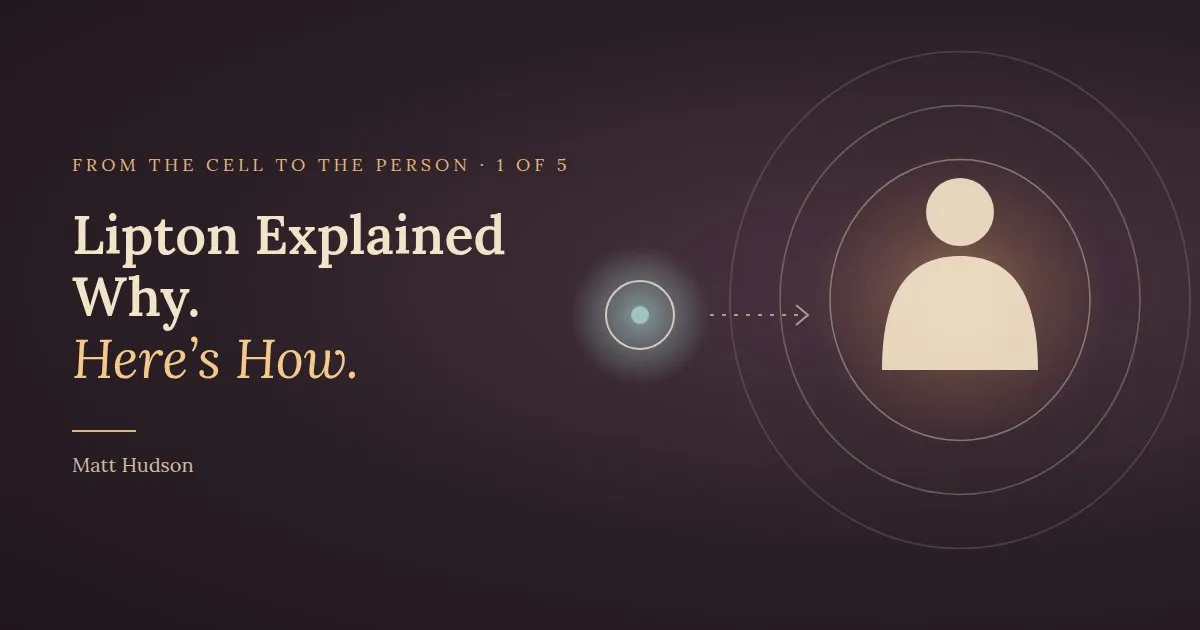
Think of it like this. Lipton looked down the microscope at one cell. I’m looking at the whole person, standing in the room, surrounded by an invisible membrane of their own. And just as the cell reads its environment through its membrane, you read your world through that space around you.
What’s stored there? Pictures. I call them Emotional Memory Images, or EMIs. They’re below conscious; you can’t simply “think of a time” and find them. But your body knows exactly where they are.
Micro to macro
So here’s the simplest way I can put it:
- Lipton showed that the cell responds to its environment, not just its genes.
- I’m showing where a person’s emotional environment is stored, and how to clear it.
One is the microscope; the other is the wide-angle lens. Same principle, different scale. And when you put them side by side, something rather lovely happens… the theory suddenly has a door handle.
Why this matters for you
You see, if your beliefs were sitting only in your thinking mind, you could argue with them and win. You could repeat a new belief until it stuck. Many of us have tried exactly that, haven’t we?
But if those beliefs are held in place by an image (an imprint sitting in the space around you), then arguing with the belief is a little like repainting the front door when the problem is round the back of the house. You can do it beautifully. It still won’t change what’s going on inside.
That’s what the rest of this series is about:
- Post 2: Why affirmations so often don’t work, and what does.
- Post 3: Why beliefs are the symptom and the image is the source.
- Post 4: How healing can happen without telling the story.
- Post 5: Why your survival system did its job a little too well.
So where do you start?
Right now, before you read any further, try something for me. Think of a feeling you’d love to be free of; a tightness, a worry, a heaviness. Now ask yourself: if this feeling were out there rather than in here, where would it be? Up? Down? Close? Far away?
Don’t do anything with it yet. Just look. Notice that your body answered before your mind had time to argue. Interesting, isn’t it?
That small question is at the heart of everything I do, and it’s built into the MindReset app, available on Apple and Google, so you can begin exploring it in your own time. If you’re carrying significant trauma, please do this work alongside a trauma-informed practitioner and keep seeing your doctor. This is something to add, not something to replace.
Lipton gave us the why. Let’s go and find the how… together.
The From the Cell to the Person series
Up next: Blog 2: Why Affirmations Don’t Work (And What Does) →
- Blog 1: Lipton Explained Why. Here’s How. (you are here)
- Blog 2: Why Affirmations Don’t Work (And What Does)
- Blog 3: Beliefs Are the Symptom; the Image Is the Source
- Blog 4: Healing Without the Story
- Blog 5: Your Survival System Did Its Job Too Well
References
- Lipton, B. H. (2005). The Biology of Belief. Mountain of Love/Elite Books.
- Forsdyke, D. R. (2009). Samuel Butler and human long term memory: is the cupboard bare? Journal of Theoretical Biology. https://doi.org/10.1016/j.jtbi.2009.01.028
- Hudson, M. (2021). Frontiers in Psychology. https://doi.org/10.3389/fpsyg.2021.716535
- Hudson, M. (2022). Frontiers in Psychology. https://doi.org/10.3389/fpsyg.2022.947952