

“They are playing a game. They are playing at not playing a game. If I show them I see they are, I shall break the rules and they will punish me. I must play their game, of not seeing I see the game.”
R.D. Laing, Knots
Last week, in Spot the Fox, I wrote about how good people disappear inside a relationship. This is the follow-up. If the last piece was about learning to see the fox, this one is about the machinery that lets a fox operate for decades without anyone noticing, and about a reader who found herself standing right next to it.
What coercive control actually is
Most people picture domestic abuse as a bruise. Coercive control has no bruise. It is the slow, patient management of another human being; who they may see, what they may spend, what they may say, and eventually what they are allowed to think. Justice for Women describe it as a form of abuse that “foregrounds the psychological… manipulation, degradation, gaslighting, and generally monitoring and controlling the person’s day-to-day life such as their friends, activities and clothing,” which “often leads to the abused becoming isolated and dependent on the abuser.” It only became a crime in England and Wales in 2015. Before that, the law could see a punch but not a cage.
Here is what I want to add to that definition, because it is the piece the definition leaves out. Coercive control is not a personality. It is a mechanism, and the mechanism is a pair of Family Rules that lock together. One person carries the rule no rules for me, my rules for you. The other carries its mirror image, your rules for me… full stop. Put those two rules in the same house and coercive control assembles itself, nudge by nudge, without anybody ever deciding to build it. Neither party can see the rules, because they run below conscious awareness, held in place by Emotional Memory Images laid down long before the two of them ever met. That is why it is so hard to spot from inside, and so hard to explain to anyone outside. Everyone is looking for a villain. What is actually there is a lock and a key.
Once you can see the mechanism you can see it everywhere; in marriages, in families, in offices, in governments. And you can see it in the story a reader sent me recently.
A reader reached out
A reader contacted me because something in her family no longer made sense. I’ll call her Anna, and I’ve changed every name and identifying detail here so that nobody involved can be recognised; the pattern, though, will be familiar to a great many people. Anna asked the right question. Not “how do we make her stop?” but “how do we understand what on earth is going on?” Understanding is where freedom starts. So let me pull the threads together.
Meet the fox: No/My and Your/.
In Spot the Fox I described a particular kind of person: one who lives by a single, hidden Family Rule… no rules for me, my rules for you. The fox doesn’t break down the door. It finds a door that is already standing open and walks in.
In Family Rules I gave the two halves of this pattern a shorthand, because once you can name them you can spot them. The fox runs No/My — no rules for me, my rules for you. And the fox always needs a partner running the mirror-image rule, which I call Your/. — your rules for me… full stop. Period. There is no second half to that rule. The sentence simply ends. Whatever you say goes, and there is nothing after it. Read the legal definition of coercive control again with those two labels in mind and you’ll find it describes, almost word for word, a Your/. living inside a No/My environment.
Clare is a fox; she is No/My through and through. Divorced once already, with grown children of her own, and now many years into a marriage with David. David is Your/. — and here is the first thing to notice. He is a man in long-term recovery, and a man who has done the hard work of getting sober has already learned that rule very deeply; your rules for me, full stop is precisely what kept him alive. Whether the rules came from the bottle or from the programme that got him off it, obedience was survival. That is the open door. Clare didn’t have to force anything. She simply found a man whose Family Rule was the perfect key to her lock. No/My met Your/. and the two clicked together like magnets.
Look at what all those years of that has done. David has shrunk to a shadow of the man he once was. His own children no longer hear from him, because Clare told him — quietly, repeatedly, over years — that they were ungrateful kids, until it became the truth he lives inside. That is not one big act of cruelty. It is a wall built brick by brick, word by word, year after year. Hypocrisy Central? Yes… but look closer and it isn’t really hypocrisy at all. It’s the rule working exactly as designed. The rules were never meant to apply to her.
Why the fox needs a closed room
Here is the piece that makes everything else make sense. Clare functions best in a closed communication system. One room, one door, and she holds the narrative. Inside that room she decides who is grateful and who is ungrateful, who is the victim and who is the villain, what was said and what was “always” meant.
Why does she need it so badly? Because the little girl inside Clare needs attention the way a plant needs light, and she has only ever learned one way to get it — be the centre of the drama, and be the wounded party when the dust settles. Watch the pattern: drunk and causing a scene at a family funeral; drunk and causing a scene at a holiday gathering; trouble whenever there are people near… and every single time, somehow, she is the one who was hurt. That isn’t a series of unfortunate evenings. That is an Emotional Memory Image running below conscious awareness, a very old snapshot of “I only matter when everyone is looking at me and someone else is to blame.” She isn’t choosing it any more than David is choosing to obey. Both of them are being run by programmes they cannot see.
And David? He has too many EMIs stacked up — every raised voice, every cold silence, every time the room turned to ice because he stepped out of line — for him to do anything other than what he does. He obeys. Your rules for me. Full stop. Please hear me on this; that is not weakness of character, it is a nervous system doing its job. The Saboteur Within keeps him safe by keeping him small.
Where the full stop goes “Snap!”
I want to say something about that full stop, because it matters for the whole family. A Your/. doesn’t stay a Your/. forever. The rule holds right up until the moment it is no longer tenable… and then it doesn’t bend, it breaks.
In Family Rules I wrote about Sally Challen. She met Richard at fifteen; he was twenty-two. Nudge by nudge, brick by subconscious brick, he built a wall around her: her friends monitored, her money controlled, a post-nuptial agreement that forbade her from interrupting him or speaking to strangers. He partied, had affairs, visited brothels, no rules for him whilst she obeyed every one of his rules for her. Textbook No/My. And Sally, for forty-one years, was textbook Your/. Her son described it as a drip, drip, drip of abuse behind closed doors that nobody could quite see. Then one day Richard sent her out into the pouring rain to fetch his lunch and, while she was gone, phoned a woman from a dating agency. SNAP! Something inside Sally broke. Forty-one years of freeze switched to fight in a split second, and she killed him with a hammer as he ate the breakfast she had made for him. She then wrote a note, “I love you, Sally,” and laid it on his body. That is how deep a Your/. runs. Sally served nine years for murder before a landmark appeal, built on the newly recognised concept of coercive control, reduced her conviction to manslaughter. The law had finally learned to see the cage.
Now, I am not for one moment suggesting David is on that road. What I want you to take from Sally is the shape of the thing. The Your/. sits in freeze. It looks like peace. It looks like a devoted husband. The people around David see a quiet man who agrees with his wife, and they think, well, he’s chosen this. He hasn’t. He is running a rule with a full stop at the end of it, and behind the full stop there is a nervous system holding its breath. The No/My, meanwhile, believes she is untouchable, because for all these years nothing has ever come back at her. Deepak Ahluwalia believed that. Richard Challen believed that. The fox never sees the Snap coming, because the fox has never once looked at the person standing behind the full stop.
So when I say keep the door to David open, this is why. There are only two ways out of a Your/. One is the Snap, which is catastrophic for everybody. The other is a window — a moment when the Your/. sees, from the outside, that the room he lives in isn’t the whole world. You opened that window the day you rang your cousins. Keep it open, quietly, without a single word of accusation, and you give him the gentler exit.
The car was never about the car
Now to the car, because this is where you can see the whole machine working in real time.
You did what they asked. David and Clare own your late father’s house now, they asked you to clear the last of your things, and you did. The car you inherited wouldn’t start, so two of your cousins kindly towed it away and stored it at theirs. Simple, sensible, kind.
But think about what that car was in Clare’s world. Sitting in her garage, it was a hook. A reason for you to have to call, to have to ask, to have to come to her door — on her terms, in her room, inside her narrative. When you removed the car, you removed the hook. Well done. That was you getting up on the perch and out of reach.
Then you did something she hadn’t planned for. You asked your cousins for help. In that one ordinary act you opened the closed system. Suddenly other people knew the story — your version of the story — before she could tell hers. The fox lost control of the room.
So what happened next? Exactly what the rule predicts. David and Clare are “shocked.” They “always wanted” you to keep the car in their garage. They “can’t believe” you would think otherwise! Do you see it? Not one word of that is about a car. It is a rapid rewrite of history so that Clare can occupy the only chair she knows how to sit in — the victim’s chair — and cast you as the one who wounded them. The little girl gets her attention, David gets to prove his loyalty, and you are invited to feel guilty for something you never did.
Laing saw this coming
That is why Laing’s words fit so beautifully. Clare and David are playing a game. They are playing at not playing a game — “we’re just a loving couple who wanted to help!” And the unspoken rule of the room is this: if you show them that you see the game, you have broken the rules, and you will be punished. The punishment is the scene, the outrage, the wounded silence, the story told about you to whoever is left in the room.
Laing wrote that after years of studying families whose communication had tied itself in knots so tight that a child could lose their grip on reality trying to make sense of them. It is a pattern of relationship, not a label for a person, and I’m not going to diagnose Clare from a distance — none of us should. But the knot itself? You’ve just untied it by describing it out loud.
The Drama Triangle, and where you stand in it
There is one more map I want to give you, because once you’ve seen it you will never un-see it. In 1968 Stephen Karpman drew a simple triangle with three corners: Victim, Rescuer and Persecutor. He called it the Drama Triangle, and the whole point of it is that nobody ever stays in one corner. Round and round they go.
Watch Clare and David move. Clare starts as the Victim — wounded, shocked, “how could Anna think that of us?” David leaps in as her Rescuer, because rescuing her is the only way he knows to keep the peace. And the moment you decline to feel guilty, they swing together into Persecutor: the cold silence, the story told about you to whoever is left in the room. Then, sure enough, Clare is the Victim again, hurt that you didn’t take the punishment quietly. Three corners, endless laps, and the only thing the triangle actually produces is drama… which is exactly what the little girl inside Clare came for. It’s her fuel.
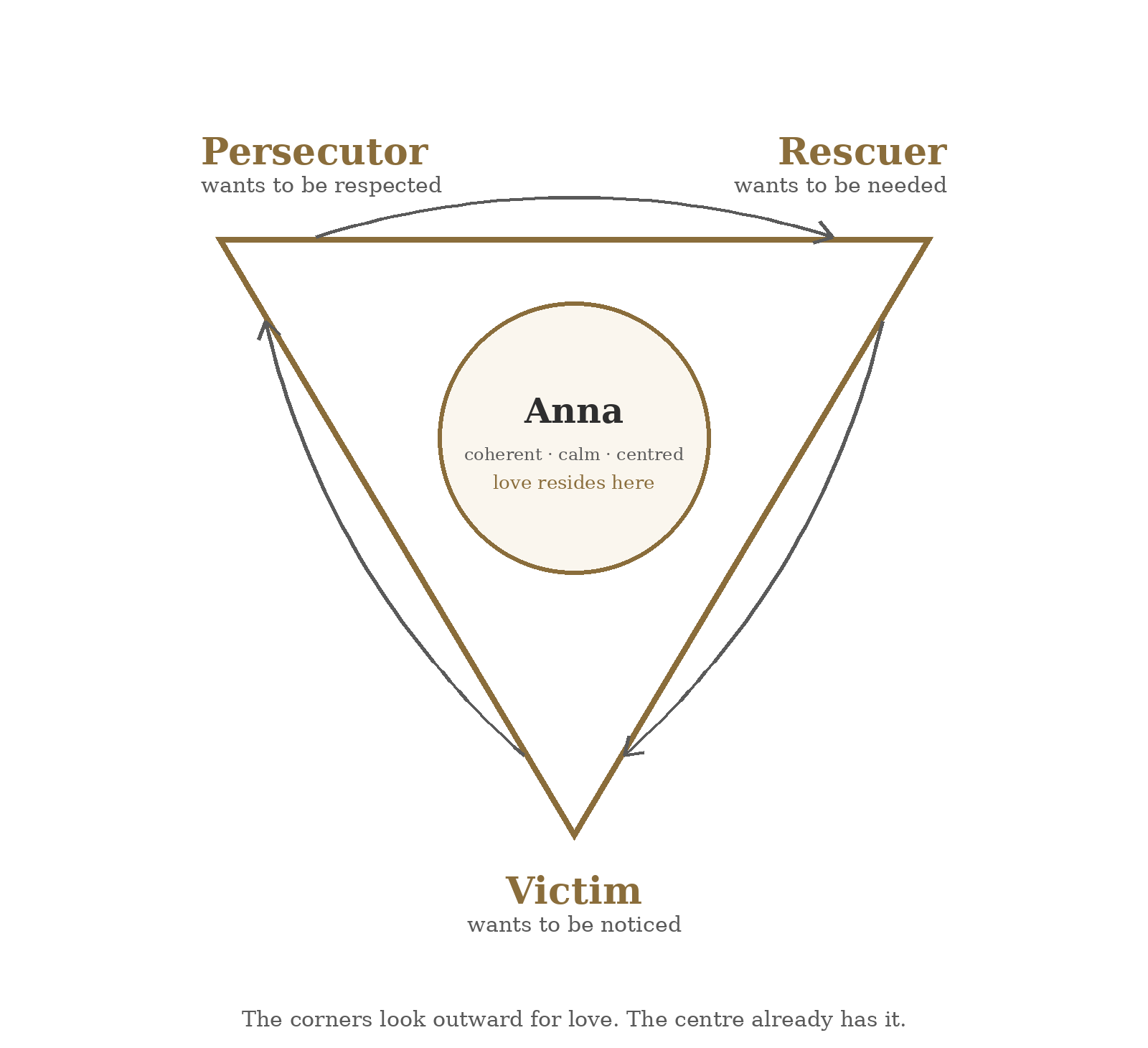
Now look at the picture. The corners are all on the outside. Every one of them is a way of reaching for something you haven’t got: the Victim wants to be noticed, the Rescuer wants to be needed, the Persecutor wants to be respected. All three are searching for love out there, in other people’s reactions. Clare and David have spent years on that fool’s errand, and they are in very good company — most of the world spends its whole life running from corner to corner looking outward for the love that was inside them all along.
And here is what I most want you to hear, Anna. There is a fourth place on that map, and it isn’t a corner. It’s the centre. Coherent, calm, centred. From the centre you can see all three corners and you don’t have to stand in any of them. You are not the Victim of David and Clare, you are not going to Rescue David from his own marriage, and you are certainly not going to Persecute anybody. You just stay in the middle, breathing, with your heart and head in the same place. Love resides in there, where you already are. Nobody in a corner can reach in and take it, and nobody in a corner can give it to you either, because it was never theirs to give.
Why can’t they join you there? I suspect the answer is the EMI. An Emotional Memory Image sits in the space in front of a person and keeps their attention fixed on the outside world, scanning for the next threat and the next scrap of attention. While it’s running, looking inward is almost impossible; the very act of turning towards yourself means turning to face the image, and the body says no. That is why taking responsibility is so hard for Clare — responsibility lives on the inside, and the inside is the one place her nervous system won’t let her go. It isn’t that she won’t. Until that image is cleared, it’s that she can’t.
So what do you do with this?
You don’t have to play. That’s the plain and simple truth of the matter. You can see the game, name it quietly to yourself and to the people who love you, and decline the invitation to feel guilty. You don’t have to argue about what they “always wanted” — arguing keeps you in the room. You simply stay out of the garage, thank your cousins, and stay reachable to David without ever stepping back into Clare’s narrative. The door to him remains open; you just don’t walk through hers to reach it.
And keep talking to each other. Your cousins, you, the rest of the family. An open loop is the one thing a closed system cannot survive. Every honest conversation between you is a window in a room that was built to have none.
David may never come back out. That’s his journey, and it is heartbreaking to watch a man you love disappear into someone else’s rules. But you have done the one thing that gives him a chance — you have shown him, without a single word of accusation, that there is a world outside the room where the rules apply to everyone. Keep the perch. Stay reachable. That’s enough.
Matt
If you recognise your own Family Rule in Anna’s story, whether it’s the No/My or the Your/., the place to start is not more understanding. It’s clearing the image that holds the rule in place. The MindReset app is free to download on Apple and Google; begin with the Stress programme. And if you want the whole map, from a kitchen table to a country, that’s Family Rules Okay.
If this is describing your own relationship, there are people who understand coercive control very well and will talk it through with you in complete confidence. In the UK, the National Domestic Abuse Helpline is free and open around the clock on 0808 2000 247.
Related reading
- Spot the Fox: How Good People Disappear Inside a Relationship
- The noose of silence: fear, family secrets and Family Rules
- How compliance leads to chronic pain and dis-ease
- Hidden family rules and the persistence of pain
References
Laing, R.D. (1970). Knots. London: Tavistock.
Karpman, S. (1968). Fairy tales and script drama analysis. Transactional Analysis Bulletin, 7(26), 39–43.
Hudson, M. & Johnson, M.I. (2023). Hidden family rules: perspective on a dysfunctional paternalistic system and the persistence of pain. Frontiers in Pain Research. https://doi.org/10.3389/fpain.2023.1303853
Hudson, M., Chaudhary, N.I. & Nordstrom, C. (2024). Folie et Société: eroding the body–mind relationship via dysfunctional paternalistic systems. Frontiers in Psychology. https://doi.org/10.3389/fpsyg.2024.1324303
Justice for Women. Coercive control. https://www.justiceforwomen.org.uk/