
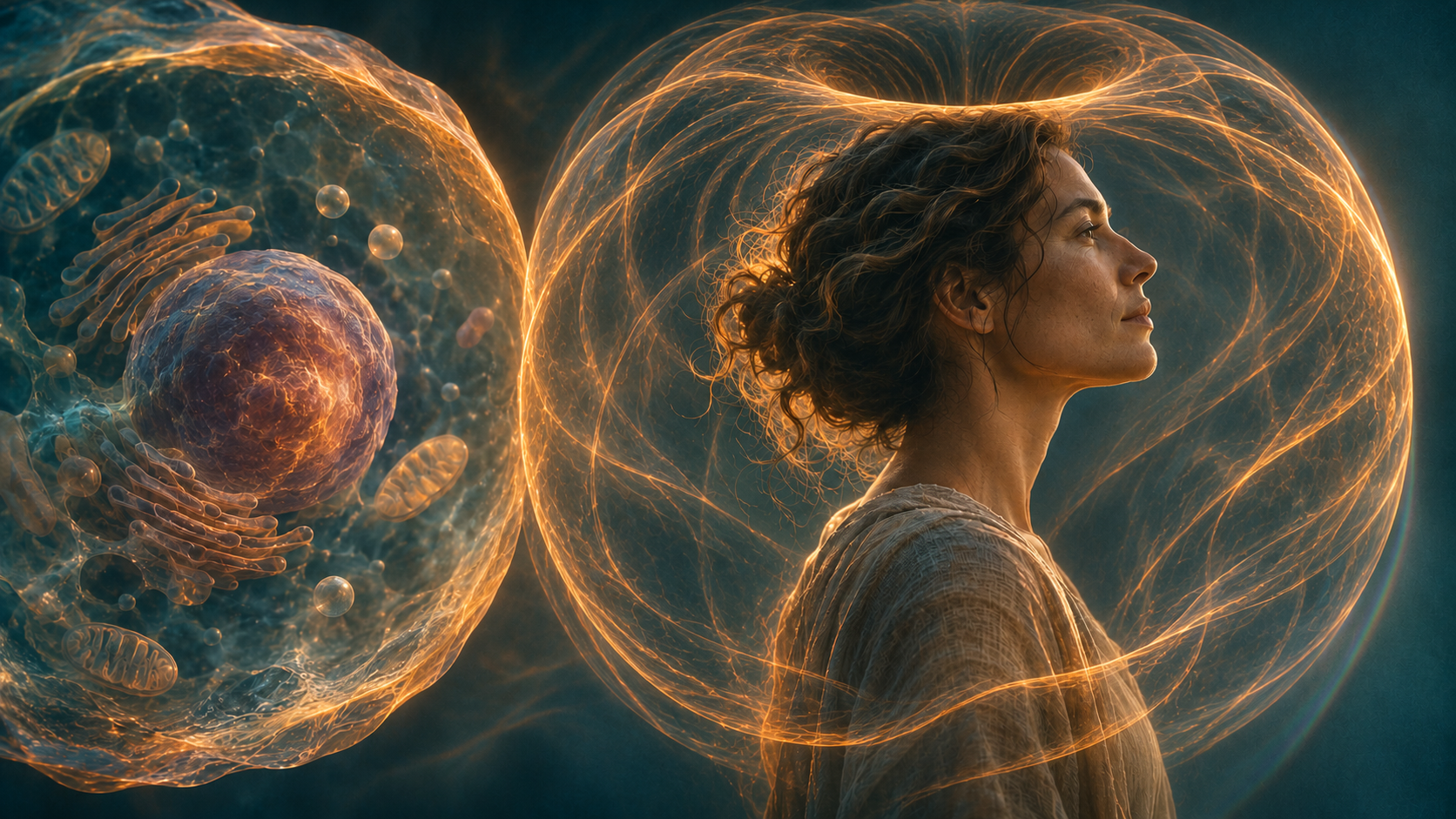
He moved the brain of the cell from the nucleus to the membrane. Now he’s moving evolution from competition to cooperation. I think the story carries on outwards… into the space in front of you.
“Lipton showed us the cell listens at its skin. I’d simply ask: where does your skin stop listening?”
Matt Hudson
Are you going to hear Bruce Lipton in London this month?
If you are, you’re in for a treat. He’s at Friends House on the Euston Road on Saturday 28 November 2026 with a day called Beyond Darwin: Healing Our Selves, Healing Our Planet, and there’s a livestream for those who can’t get to London. I’ll be there, in the audience, with a notebook. I’ll say straight off that I’m nothing to do with the organisers; I’m simply a grateful reader who has bought a ticket. The Biology of Belief changed the questions I was asking, and I’d like to tell you why, and where those questions led me.
So let me ask you one first. If a belief can change your biology… where is the belief?
What The Biology of Belief actually says
Lipton was a cell biologist teaching medical students, and the textbook told him what it told everybody: the nucleus, with its genes, is the brain of the cell.
Then he looked at what happens when you take the nucleus out. Does the cell drop dead? No! It carries on, eating, moving, avoiding toxins, for weeks, sometimes a couple of months. It only fails in the end because it can’t make new parts. A brain you can remove without the creature noticing isn’t a brain. It’s a library.
So what is doing the thinking? His answer was the membrane; the skin of the cell, studded with receptor proteins that read the world outside and effector proteins that act on what they read. He famously called it the “mem-brain”.
Picture a house. We’d all assumed the intelligence was in the filing cabinet in the study. Lipton said look again; the intelligence is in the doors and windows, because that’s where the house meets the weather.
From there the rest of the book follows. Genes are blueprints, and the environment, or more precisely the cell’s perception of the environment, decides which blueprints get read. That’s the heart of what he calls the new biology, and it’s why he says we are not victims of our genes.
The programmes we never chose
The part of Lipton’s work that lands hardest with my own clients is what he says about childhood. He argues that for roughly the first seven years a child isn’t weighing things up; she’s downloading. The household goes straight in, unfiltered, as subconscious programmes, and those programmes go on to run most of adult life, 95 per cent of it by his reckoning, while the conscious mind takes the credit.
Does that sound familiar? It should. It’s exactly what I mean by Family Rules: below-conscious instructions we absorb so early, and so completely, that we never experience them as rules at all. Don’t make a fuss. Be ready. Don’t get above yourself. Nobody sat you down and issued them. They arrived in a look, a silence, a door.
Lipton gives you the biology of why they stick. What I’ve spent my working life on is a different question. Where are they kept, and how do you get at one?
Beyond Darwin: where Lipton stands now
That was the Lipton of twenty years ago. The Lipton coming to London has moved on, and his new position sits closer to my own work than anything he’s written before.
His new book, written with Patricia King, is called Beyond Darwin: How Epigenetics, Quantum Science, and Cooperation Shape Humanity’s Future, and the day at Friends House takes its name. I’ve been reading it this week. The opening chapter, “Lamarck’s Red Pill”, tells you where he stands. His hero isn’t Darwin. It’s Jean-Baptiste Lamarck, whose theory Lipton describes as a “symbiotic and cooperative” relationship between a living thing and its environment, and he says it matched what he saw in his own laboratory; the fate of his cloned cells depended on the dish they were grown in, not on the DNA in their nuclei. He calls survival of the fittest a “win at any cost” directive, and one of the most destructive influences on our culture. Evolution, he says, is better understood as cooperation.
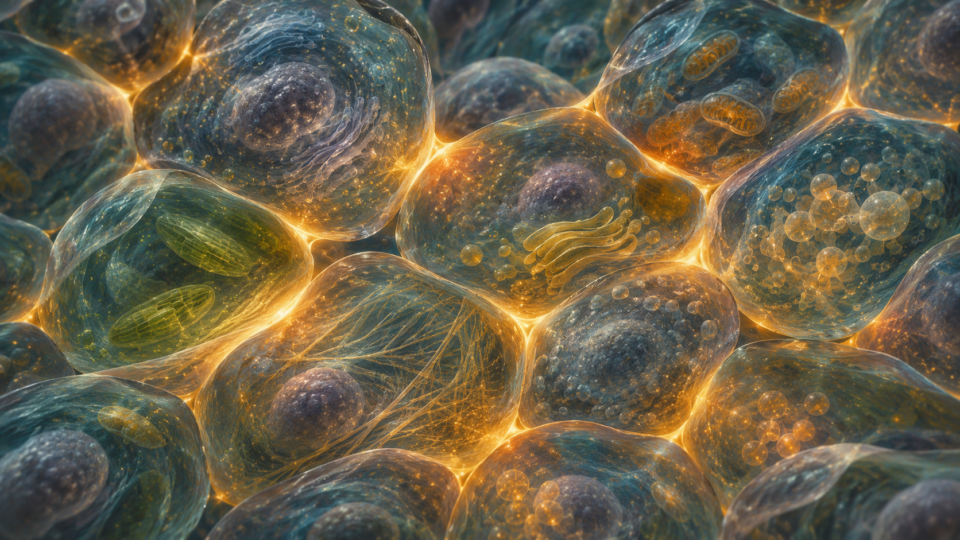
Fifty trillion cells don’t make a body by fighting one another. They make it by working together. He draws quantum physics, epigenetics and neuroscience into what he calls a convergence of body, mind and spirit, and he says the point of it all is to help us move from passive victims to responsible co-creators.
Two things in that chapter made me sit up.
The first is inheritance. Lipton points to the epigenetics research showing that an organism can adapt to its environment and pass that adaptation on to the next generation without any change to the DNA itself. Lamarck, laughed at for two hundred years, turns out to have been at least partly right. Now, what is a Family Rule if not exactly that? An adaptation to one household, handed down to children who never lived in it.
The second is scale. In The Biology of Belief, he reminds us, he wrote about how one person can deprogram the self-destructive myths lodged in the subconscious. In this book he says a whole culture can do the same, and he names four myths he thinks we’ve all been programmed with. The first is that we’re slaves to our genes; his answer is that genes are regulated by signals from the environment, carried by the nervous system. A culture’s myths are Family Rules written large. Same mechanism. Bigger house.
That’s no accident, by the way. His second chapter is about fractals; the same pattern repeating at every scale, each one nested inside the next like a set of Russian dolls. Hold on to those dolls. We’ll need them in a minute.
And the membrane? Still there, with a chapter of its own, “The Magical Membrane”, and he calls it his favourite topic. But listen to what he says about it now. The receptors on a cell’s surface are antennas, and they respond to a signal whether it comes from a molecule or from what he calls a “nonphysical vibrational field”. The cell, he says, is a programmable chip. And the programmer lies outside the cell.
Read that last line again. The programmer is outside.
Then, in “The Quantum Language of Cells”, he goes the whole way out. Energy fields, he says, “have no borders”. They spread like ripples from a pebble dropped in a pond, and where two sets of ripples meet they either build each other up or cancel each other out. That, for Lipton, is how a cell reads its world; the signal that is in tune with the receptor is the one that gets through. And he says it plainly: the energy fields around us, consciousness above all, shape the character of a human life.
From the gene, to the membrane, to the field. See how that works? He’s walking in the same direction I am.
Why does that matter to somebody whose stomach hasn’t settled in twelve years?
Because a Family Rule is survival of the fittest inside one small house. A child works out, in a split second, what it takes to stay safe among the people she depends on, and her body competes for that safety for the rest of her life. Braced. On watch. One part of her holding another part down. That isn’t a body cooperating with itself. It’s a body at war, and a body at war is exactly what I mean by dis-ease.
And victim to co-creator? I’ve been saying it in different words for years. Not “what’s wrong with me?” but “what happened to me?” Your symptoms are messages, not life sentences.
So Lipton and I have arrived at the same door from opposite sides. He came from the cell and the species. I came from the clinic. He tells you why cooperation is the natural state of a living system. My question is the practical one: what, precisely, is stopping yours?
One step further out
Here’s where I part company with the textbook, and go a step beyond Lipton too.
In 2009 the Canadian biologist Donald Forsdyke looked at the cases of people who have lost a startling amount of brain tissue and kept their memories, and asked, very politely, whether we’re certain memory is stored inside the brain at all. He raised the possibility that some of it is held outside the body. Extracorporeal.
And here, at last, is Lipton saying something very close. In chapter 12 of Beyond Darwin he writes that our personal identity is “not contained within the body”. It is received from the environment, he says, by receptors on the surface of our cells. He asks us to think of the body as a television. The programme isn’t inside the set. Break the set, and the broadcast carries on.
He’s talking about who you are. I’m talking about what happened to you. But once a cell biologist of his standing says the self is received rather than stored, asking whether memory might be held outside the body stops sounding quite so outlandish, does it not?
Now pick up the Russian dolls. In Beyond Darwin (chapter 2) Lipton says the structure and function of a cell is self-similar to that of a human being. The small doll is a miniature of the big one.
And in chapter 4 he goes further. Awareness, he says, comes down to membrane; the more surface a creature has for reading its world, the more aware it is. A bacterium runs out of room inside its shell. So, he says, do we. The human brain sits in a “rigid capsule”, the skull, and it has folded itself over and over to squeeze more surface in. Once there’s no room left, the only way on is outwards.
Well then. If the intelligence of the small doll is at its boundary, where the cell meets its world, where is the boundary of the big doll? What is the membrane of a whole person? Is it your skin?
I don’t think so. I don’t think our awareness ever did stop at the capsule. Neuroscience has known for decades that the brain maps the space immediately around the body, the space within arm’s reach, quite differently from the space beyond it. It’s called peripersonal space, and it behaves like a second skin. Walk too close to a stranger on a train and you’ll feel yours.
In my papers with Professor Mark Johnson (Frontiers in Psychology, 2021 and 2022) I proposed that this is where the most urgent memories sit. I call each one an Emotional Memory Image, an EMI: a wordless snapshot, taken in a moment of threat, held out in the space in front of you where it can be checked in a fraction of a second.
If Lipton’s membrane is the doors and windows of the house, the EMI is on the front path. You meet it before you ever reach the door.
Lipton gives me the physiology for that as well. In his chapter on stress, “Our Saber-Toothed Tigers”, he describes what the alarm does. Blood leaves the gut for the arms and legs. The immune system is stood down. And blood is drawn away from the thinking forebrain to the faster, instinctive hindbrain, because the conscious mind is too slow for a crisis. That’s why the boss says have you got a minute? and Martin’s body has answered before the thought arrives.
A body, he says, can’t be in full growth and full protection at once. It was built to outrun the tiger and be back to normal in minutes. And then comes the line I’d underline twice: there’s not a tiger in sight, and still so many of us are stuck in protection.
So where is the tiger? Lipton’s answer is the modern world; the mortgage, the traffic, the news. I think that’s half of it. The other half is that the tiger is a picture, about an arm’s length in front of you, and it has been there since you were small. He even quotes the researchers who found that childhood adversity “gets underneath the skin”. My only quarrel is with the direction. I’d say it starts just outside it.
I should be plain with you. This is a theory, and it’s mine; Lipton and Forsdyke haven’t signed up to it, and Lipton’s own ideas are still argued over by mainstream biologists. I’d rather you knew that than thought it was settled.
What I can tell you is what I see when I ask people one question.
The belief you can point at
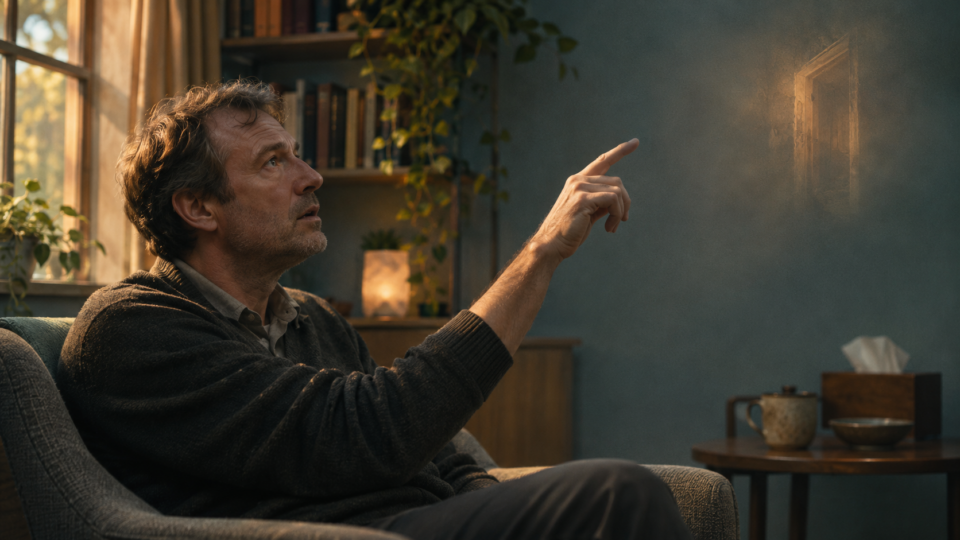
Martin, we’ll call him, had read The Biology of Belief twice. He had the affirmations on the bathroom mirror.
“I believe the right things,” he said. “I’ve done the work. So why does my chest still go tight every time my boss says have you got a minute?“
Because the belief he’d changed was the one in words. The one running his chest never had any.
Lipton would understand Martin perfectly. In Beyond Darwin he tells a story against himself. In his early talks, audiences would ask, in so many words, if beliefs are so powerful, Dr Lipton, why does your life look the way it does? What he took from the embarrassment was that knowledge held in the mind, but not used in life, is powerless.
I’d put it a little differently. It isn’t that Martin wasn’t using what he knew. It’s that what he knew was upstairs, and the picture was out in front.
So I asked him. “That tightness. If it were out there rather than in here, where would it be?”
He laughed. Then his hand came up, about eighteen inches in front of his face, slightly above eye level.
“There,” he said. “Looking down at me.”
Whose face? I didn’t ask, and he didn’t say. We didn’t need to dig. We worked with the picture where it sat, a few minutes, and then came the breath, the long one they all do.
“It’s gone,” he said. “It’s just… not there.”
He rang me three weeks later. His boss had said have you got a minute? and Martin had said, “Course,” and only noticed in the lift that his chest hadn’t moved.
See how that works? Lipton is right that perception controls biology. But the perception that matters isn’t an opinion you hold. It’s a picture your body is looking at.
Why this matters for undiagnosed trauma
In his third chapter Lipton boils the whole of epigenetics down to a single line: a signal from the environment switches the gene on. The gene can’t do it by itself. He says that one insight does away with the “victimology” of believing your genes are your fate.
So here’s my question. Which environment is Martin’s body reading when his chest goes tight? Not the office. The office is perfectly safe. It’s reading the picture. An EMI is an environmental signal you carry with you, and it never switches off. In Lipton’s picture of the pond, it’s a pebble dropped forty years ago whose ripples are still crossing everything that arrives today.
Lipton also shows, with experiment after experiment, that a living thing under stress doesn’t break. It adapts. I’d ask you to hear that about your own body. Your symptoms aren’t a fault. They’re an adaptation, to a house you no longer live in.
When that picture fires day after day for forty years, the body pays. The gut that won’t settle, the back that won’t ease, the tests that keep coming back normal. That’s what I mean by undiagnosed trauma, and it’s why I spell it dis-ease; a whole system ill at ease long before it has a name. The symptoms are real and physical. It’s the origin that’s out of sight.
The invitation on his last page
Lipton ends Beyond Darwin with a generous sentence. His work, he says, can be considered a “foundation” for a more inclusive theory, one that can be modified and adjusted to seed the next step. I’ll take him at his word.
Look at where he leaves us. In his closing summary he says that more than six in ten of our subconscious programmes, by his reckoning, are limiting ones, handed down the generations in a child’s first seven years. The underlying problem, he says, is that we don’t know they’re there. And his remedy? Awakening to the facts.
But he’s already told us, in his own story, that knowing isn’t enough. Martin knew. Lipton knew!
So here’s the step I’d offer. Don’t only wake up to the programme. Find out where it is.
So where do you start?
If you’re going to hear Lipton on the 28th, take this question with you. Every time he says belief, ask yourself, and where is mine? And if you see me in the queue for a cup of tea, do come and say hello. I’d love to know where yours turned out to be!
Then try it. Think of something that tightens you. Ask, kindly, if this feeling were out there, where would it be? In front? Above? Close? Far away? Don’t do anything with it. Just look, and notice that it has a place.
That’s the first move in everything I do, and it’s the first thing the free Stress programme in MindReset walks you through. Download MindReset free on Apple or Google and begin there; it costs nothing and it’s the doorway.
And please keep seeing your doctor. This work sits alongside good medicine, never instead of it.
Lipton opened the door from the nucleus to the membrane. Step through it, and keep walking. You’ll find what you’re looking for about an arm’s length in front of you.
Carpe diem!
Questions people ask
When is Bruce Lipton speaking in London in 2026?
Saturday 28 November 2026, at Friends House, 173–177 Euston Road, London NW1 2BJ. The day is called Beyond Darwin: Healing Our Selves, Healing Our Planet, it’s run by TCCHE, and there’s a livestream. Details and tickets are on the event page. I’ll be attending as a member of the audience; I’m not connected with the organisers.
What is Bruce Lipton’s Beyond Darwin about?
His new book and workshop argue that evolution is driven by cooperation rather than Darwinian competition. He revives Lamarck, draws on epigenetic inheritance, and says a culture can deprogram its self-destructive myths just as a person can. I see the same shift in one person at a time; a body run by an old Family Rule is competing for safety, and when the Emotional Memory Image clears it can cooperate with itself again.
What is The Biology of Belief about?
Bruce Lipton’s argument that the cell membrane, not the genes in the nucleus, governs how a cell behaves, and that our perceptions and beliefs therefore shape our biology.
What does Bruce Lipton say about the cell membrane?
That it’s the cell’s real “brain”. Its receptor proteins read signals from the environment and its effector proteins turn those signals into behaviour. A cell with its nucleus removed can carry on for weeks.
What does Bruce Lipton mean by subconscious programming?
That in roughly the first seven years of life a child absorbs the behaviour and beliefs of the household without filtering them, and those programmes run most of adult behaviour. In my work these are Family Rules.
Where are memories stored, according to Matt Hudson?
I propose that the memories driving stress and dis-ease are held as Emotional Memory Images in peripersonal space, the space within reach in front of the body. It’s a theory, building on Forsdyke’s question about extracorporeal memory and extending Lipton’s membrane idea outwards. In Beyond Darwin Lipton himself writes that personal identity is “not contained within the body” but received from the environment.
How is an Emotional Memory Image different from a limiting belief?
A belief is in words and you can argue with it. An EMI is a picture with no words, laid down before you could reason, and it fires before thought. That’s why affirmations so often leave the body unmoved.
References
Lipton, B.H. (2005). The Biology of Belief: Unleashing the Power of Consciousness, Matter and Miracles.
Lipton, B.H., with King, P. (2026). Beyond Darwin: How Epigenetics, Quantum Science, and Cooperation Shape Humanity’s Future. Foreword by Gregg Braden.
Forsdyke, D.R. (2009). Samuel Butler and human long term memory: is the cupboard bare? Journal of Theoretical Biology. https://doi.org/10.1016/j.jtbi.2009.01.028
Hudson, M. & Johnson, M.I. (2021). Split-second unlearning: developing a theory of psychophysiological dis-ease. Frontiers in Psychology. https://doi.org/10.3389/fpsyg.2021.716535
Hudson, M. & Johnson, M.I. (2022). Definition and attributes of the emotional memory images underlying psychophysiological dis-ease. Frontiers in Psychology. https://doi.org/10.3389/fpsyg.2022.947952
Hudson, M. et al. (2025). Eye movements and emotional memory images (EMIs): unravelling the path to adult health from childhood adversity. https://www.sciencedirect.com/science/article/pii/S3050613125000269
Names and details have been changed.