
What Did Gabor Maté Mean by “What Happened to You?” You’ve asked what happened to you — and the answer landed in your body: chronic illness, stress, emotion held like breath behind a locked door. But understanding why you’re ill doesn’t tell you how to change it. That’s where my 2021 paper on the Emotional Memory Image comes in — the below-conscious imprint keeping your body saying no, and healing through remembering to forget. Try MindReset alongside a trauma-informed practitioner and your doctor.
What Did Gabor Maté Mean by “What Happened to You?”
Gabor Maté’s question — ‘not what’s wrong with me, but what happened to you?’ — flips the medical script, and I agree with it fully: it asks us to look at the story behind the symptom rather than the symptom alone. It is a small shift in wording with an enormous shift in stance.
At its heart, Maté reframes illness as an adaptation to early adversity and emotional repression, not a personal failing. You did not choose your coping patterns; your body built them to keep you safe. That distinction matters, because shame keeps people stuck and understanding helps them move.
This view draws on research into adverse childhood experiences and the biopsychosocial model, which holds that biology, mind and relationships all shape health together. Maté weaves those threads into a question any of us can ask ourselves about our own mind body connection.
I have sat with many people in my clinic who arrived believing their body had betrayed them. When they start asking what happened rather than what is wrong, something in the room softens. That softening is where healing begins, and it is why I build on Maté’s question rather than around it.
Trauma as What Happens Inside Us — and Illness as the Body Saying No
Maté’s central insight is that trauma isn’t the event itself but what happens inside us — the protective patterns we build, often at the cost of authenticity — and that chronic illness can be the body’s way of saying no when we couldn’t. A child learns to swallow anger to keep the peace. An adult keeps swallowing it, and the body carries the cost.
In When the Body Says No, Maté explores the link between emotional repression and conditions including autoimmune illness, where the immune system turns on the self. He also describes how chronic stress wears down the body over years, and how healthy anger and clear boundaries act as protection rather than indulgence. Anger, handled well, is information. Boundaries are a non-negotiable human need, not a luxury.
I want to be careful here. ‘The body says no’ is a metaphor for real physiological stress responses, not a dismissal of physical pathology. Your symptoms are physical and real, and nobody should hear this and stop seeing their doctor. What the metaphor adds is a second question: what has your body been trying to protect you from?
That is why this matters for change. If illness is partly the body saying no, then learning to say no yourself, with compassion and boundaries, gives the body less to carry. The body mind connection runs both ways, which means the conversation can move forward.
Where Maté’s question leaves many people is a second one: I understand why I became ill, so how do I change it? That is the gap my work tries to fill. In my 2021 paper I described the Emotional Memory Image, or EMI, a below-conscious imprint that keeps the body saying no long after the danger has passed. EMIs appear to sit in the space around the body, in what researchers call peripersonal space, which fits Forsdyke‘s extracorporeal memory hypothesis. I present that as a hypothesis, not settled fact. Change, in my experience, comes through memory reconsolidation: remembering to forget, in the sense of updating a memory rather than erasing it. The MindReset app, available on Apple and Google, supports that process between sessions. I always suggest working alongside a trauma-informed practitioner and continuing to see your doctor. There is real hope here, and it starts with a kinder question.
If I Understand Why I’m Ill, Why Can’t I Change It?
You can understand why you’re ill and still feel stuck, because insight lives in the thinking mind, while the patterns that keep the body saying no live below consciousness, in emotional memory. I see this in my clinic constantly. Someone has read When the Body Says No, mapped their childhood experiences, spotted the emotional repression, and can explain their chronic stress beautifully. Yet the illness hasn’t budged.
Here’s the metaphor I come back to: knowing the map doesn’t move the car. You can study every road, every roundabout, every shortcut, and still sit in the driveway with the engine off. Understanding is the map. Change is the journey, and it happens somewhere else entirely.
This is the open question Maté’s framework leaves us with, and I don’t think he’d mind me saying so. His work answers what happened to you with real compassion and rigour. What it doesn’t fully answer is how to reach the implicit, embodied imprint underneath the story. The part that flinches before you’ve thought a thing.
That’s the gap I’ve spent years working on. We need a method that targets the below-conscious imprint directly, not just the narrative wrapped around it. In my 2021 paper I called that imprint the Emotional Memory Image, and it’s where the body’s no actually lives. Reach it, and the stress response can finally update.
What Is an Emotional Memory Image (EMI)?
An Emotional Memory Image, EMI for short, is the below-conscious imprint that keeps the body saying no, a sensory-emotional snapshot formed in childhood that continues to drive present-day stress responses.
I set out the concept in my 2021 paper, and it sits neatly alongside Gabor Maté’s central question. He asks what happened to you. I wanted to name what that happening left behind inside the body.
An EMI is not a recovered memory and it is not a story you tell about your past. It is an implicit template, a felt sense of how the world works, held in the body rather than in words.
Think of it as a mould rather than a memory. The mould shapes each new experience as it pours in, quietly, long before your thinking mind notices. The next section shows how that template keeps the body in a stress response.
The Below-Conscious Imprint That Keeps the Body Saying No
EMIs form when early emotional experiences, especially those involving unmet needs or threat, get encoded as sensory fragments: a tone of voice, a feeling of tightness, a flicker of an image.
One client described a tight band around the chest whenever she was criticised at work. It felt physical, and it was. When we looked gently at the felt sense, it carried the shape of a childhood moment of being silenced, told her view did not count.
That snapshot now fires automatically, outside her awareness. Her mind reads a raised eyebrow in a meeting and her body responds as if the old threat were present. Chronic stress follows, and over time that stress can feed into dis-ease.
Let me be clear. This is not about blaming parents. Most caregivers were doing their best with what they had. The point is to understand a protective pattern, not to assign fault.
In my 2021 paper I describe how these imprints operate below consciousness, shaping emotional repression and the mind body connection without any deliberate choice on your part. Naming the pattern is the first step towards loosening its grip, and that is where healing begins.
Where Do EMIs Live? The Peripersonal Space Around the Body
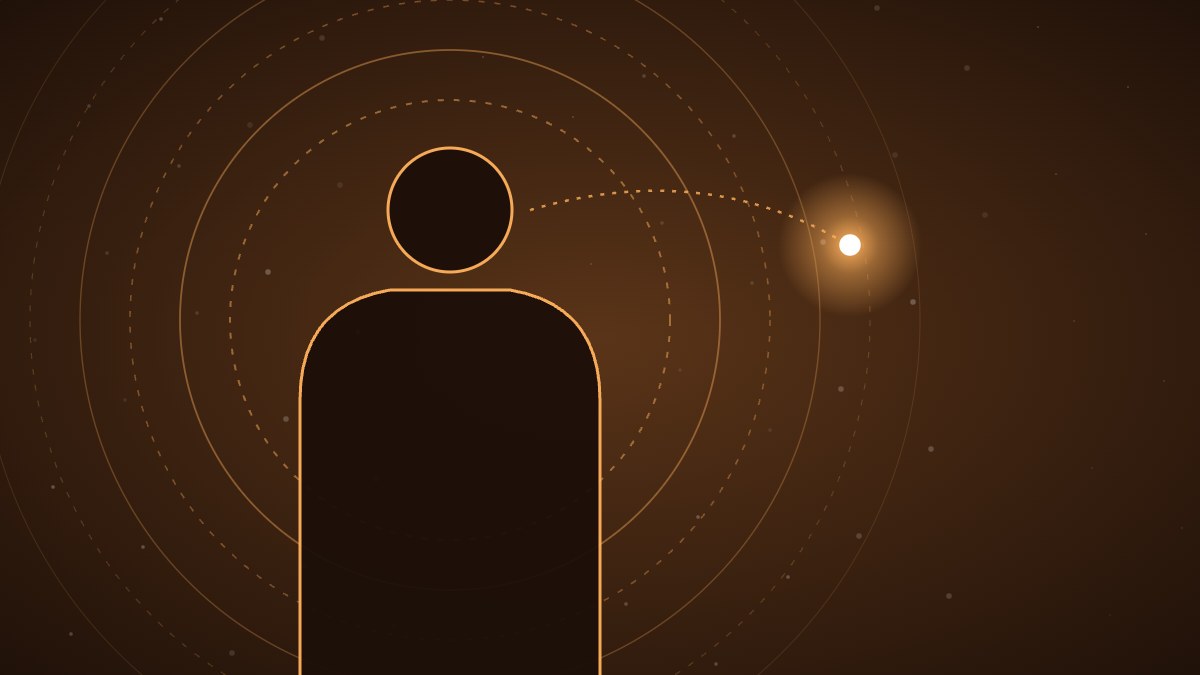
When I ask clients where they feel an EMI, they often point to the space just around their body — the peripersonal space — rather than inside it. That answer surprised me at first. I expected people to touch their chest or their stomach. Instead, their hand would hover a few inches away, tracing something invisible.
Peripersonal space is the bubble of space immediately surrounding your body. Your brain treats this zone as part of the self, not as the outside world. It is where you reach for a cup, flinch from a sudden noise, or sense someone standing too close. In my 2022 paper, I set out why this boundary matters for understanding emotional memory (doi 10.3389/fpsyg.2022.947952).
Think of it like the gravel path around a house. It is not the building itself, yet you defend it as though it were. Your mind body connection seems to draw the edge of the self a little wider than the skin.
This is the ground beneath Maté’s question. If trauma is what happened inside you, the imprint may also settle just outside you. The body keeps saying no, and the echo of that no may linger in the air around the body. That is what I want to explore next.
Extracorporeal Memory: A Hypothesis, Not a Certainty
Extracorporeal memory is the hypothesis that memory can be encoded in the space around the body — and it’s consistent with Forsdyke’s extracorporeal memory hypothesis (doi 10.1016/j.jtbi.2009.01.028). I want to be plain with you: this is a hypothesis, not established fact. It fits what I see in clinic, and it fits the science of how the brain models the body’s surroundings as part of the self. But fitting is not proof.
Why take it seriously at all? Because the body mind connection already blurs the line between inside and out. You can feel watched from behind without seeing anyone. You can sense a room’s mood before a word is spoken. If the brain maps the space around you as self, then emotional memory could plausibly settle there too.
This is an emerging area, and more research is needed. I hold it with open hands. I would rather offer you an honest hypothesis than a false certainty, because you deserve the truth about your own healing.
What I can say with confidence is this. The EMI gives you a place to look, and looking is where change begins. You can explore this gently with the MindReset app on Apple and Google, work alongside a trauma-informed practitioner, and keep seeing your doctor. Memory reconsolidation, remembering to forget, is the hopeful part. The body can learn a new answer, and that answer can be yes.
How Does Memory Reconsolidation Work — Remembering to Forget?
Memory reconsolidation is the brain’s way of updating old memories — and it’s the mechanism behind ‘remembering to forget’: you bring the emotional memory to mind, and in that brief window of instability, you can rewrite its meaning. This is the heart of my work. Maté asks what happened to you, and I would add: once you know, how do you let the body stop bracing?
In my 2021 paper, I described the Emotional Memory Image (EMI) as the below-conscious imprint that keeps the body saying no. It sits just outside conscious reach, yet it drives the chronic stress response that wears the body down. Reconsolidation research suggests that when a memory is reactivated, it briefly becomes changeable before it is stored again. That window is where healing can happen.
So how do you work with it? Think of it like editing a document while it’s still open. You don’t delete the memory. You change the emotional charge attached to it, so the body stops treating the past as a present threat. Here are the steps I take people through.
- Evoke the EMI safely. Through guided imagery, you gently bring the emotional memory to the surface, just enough to feel it, not so much that you’re overwhelmed.
- Hold it in working memory. While it’s active, you introduce a new, corrective emotional experience — a sense of safety, compassion or connection that wasn’t there before.
- Let the reconsolidation window open. For roughly ten to sixty minutes, the original imprint can update. You stay present and let the new feeling land.
- Repeat as needed. One pass rarely rewrites a lifelong pattern. You return, gently, over sessions until the charge softens.
Sessions often run thirty to sixty minutes. The common mistakes are rushing, intellectualising the memory instead of feeling it, and avoiding the emotion altogether. This is best done with a trauma-informed practitioner, alongside your doctor. The MindReset app, available on Apple and Google, can support the work between sessions.
How Do Undiagnosed Trauma and Dis-ease Connect?
Many people carry undiagnosed trauma, adverse childhood experiences that were never named, and their bodies express the unresolved stress as dis-ease, from autoimmune flares to chronic pain. Nothing was ever labelled, so nothing was ever addressed.
I write dis-ease with a hyphen on purpose. It signals the lack of ease running through the body, not a dismissal of pathology. Your diagnosis is real. The hyphen simply asks what else is going on beneath it.
Gabor Maté opened this door for all of us. His question, “what happened to you? turns the spotlight from fault to history. My work picks up where that question lands: if the body is still saying no, what is it holding, and how do we help it let go?
Why Your Symptoms Are Real and Physical
Your symptoms are real and physical, full stop. The fact that they’re linked to emotional memory doesn’t make them “all in your head”; it means your body is responding to stress in measurable ways. Chronic stress elevates cortisol and inflammatory markers, which can aggravate autoimmune conditions such as ankylosing spondylitis.
Maté’s work documents associations between emotional repression and conditions including breast cancer and Alzheimer’s. Associations, note, not sole causes. He is careful about that, and so am I. Think of it as one thread in a tapestry, not the whole picture.
In my 2021 paper I described the Emotional Memory Image, a below-conscious imprint that keeps the body saying no long after the original stress has passed. I believe these images sit in the peripersonal space around the body, which fits Forsdyke’s extracorporeal memory hypothesis. It remains a hypothesis, and I hold it as one.
Here is the reassurance. None of this is about blame, and none of it means your illness is your fault. Your body has been doing its best with what it was given. Understanding that is the first step towards healing, not a reason for guilt.
How Can the MindReset App Support This Work?
The MindReset app, available on Apple and Google, is a self-guided tool I helped develop to help you identify EMIs and begin the process of memory reconsolidation safely at home. It grew out of my clinical work and my 2021 paper, where I set out the Emotional Memory Image as the below-conscious imprint that keeps the body saying no.
So what does it actually do? The app offers guided exercises to evoke an emotional memory and then gently update it, working on the principle of remembering to forget. Everything is paced, with clear stopping points and safeguards, so you are never pushed faster than you can manage. Think of it as learning to hold a difficult memory in soft hands rather than white knuckles.
I want to be plain about its limits. MindReset is not a replacement for therapy, and it is not a cure. It works best alongside a trauma-informed practitioner who can help you make sense of what surfaces, and you should keep seeing your doctor about your physical health throughout. The body and mind are one conversation, and no app should ever sit alone in that room.
What it can offer is steady, private practice between sessions: a way to build emotional awareness, notice where tension lives in your body, and start updating the memories that keep chronic stress switched on. If you are curious, treat it as a companion to proper care, not a shortcut around it. Small, kind steps, repeated, are how the body begins to soften its no.
Why Work Alongside a Trauma-Informed Practitioner and Your Doctor?
Working with a trauma-informed practitioner and your doctor is essential because memory reconsolidation can bring up strong material, and you need a safe container, plus medical oversight for any physical symptoms. When you reopen an emotional memory, it is a little like opening a cupboard that has been jammed shut for years. Best to have someone steady beside you when the door finally gives.
Here are the five reasons I keep coming back to:
- Safety and stabilisation. You need solid ground before you revisit anything difficult.
- Medical differential diagnosis. Your symptoms are real and physical, so they deserve a proper medical look.
- Integration of emotional and physical care. The mind body connection works best when both sides are tended together.
- Avoiding re-traumatisation. A skilled practitioner paces the work so it does not overwhelm you.
- Collaborative care. Everyone involved shares a clear picture of your healing.
On timing, check in with your doctor before you start, then review progress every few months. I often suggest the MindReset app for the daily between-session work, but it sits alongside professional care, never instead of it. Compassion and boundaries are the guiding principles here. Compassion for what happened to you, and boundaries that protect your energy.
How This Builds on Maté’s Framework — and Where It Extends It
I build on Maté’s framework by agreeing fully that the question is ‘what happened to you?’ — and I extend it by offering a specific mechanism, the EMI, and a method, memory reconsolidation, to change the below-conscious imprint. His work explains why you became ill. Mine asks what happens next.
Maté shows how emotional repression and chronic stress turn childhood experiences into adult dis-ease. That insight is profound, and I would not want to water it down. But understanding why the body says no is not the same as teaching it to say yes. That is the gap I wanted to fill.
In my 2021 paper I set out the Emotional Memory Image (EMI): the below-conscious imprint that keeps the body braced long after the danger has passed. I have proposed that EMIs sit in the peripersonal space around the body, a hypothesis consistent with extracorporeal memory work. Change, I suggest, comes through memory reconsolidation: remembering to forget.
So here is the hopeful close. Change is possible, and you can learn to remember to forget. The MindReset app is one way to work with this gently, alongside a trauma-informed practitioner and your own doctor. Be kind to yourself on the journey. You are not broken, you are carrying something, and that something can soften.
Frequently Asked Questions
What does “Gabor Maté Asked What Happened to You. Here’s How the Body Stops Saying No” actually mean?
It refers to building on Gabor Maté’s core insight: trauma is what happens inside us, and illness is often the body saying no. Maté reframes the question from “what’s wrong with me?” to “what happened to you?” — and this topic goes one step further, asking: if I understand why I’m ill, how do I actually change it? The answer lies in the below-conscious imprint that keeps the body saying no, and in how memory reconsolidation can finally let the body stop bracing.
How does the Emotional Memory Image (EMI) explain why the body keeps saying no, even after I understand Gabor Maté Asked What Happened to You. Here’s How the Body Stops Saying No?
The Emotional Memory Image (EMI) is the below-conscious imprint that keeps the body saying no (Hudson 2021, doi 10.3389/fpsyg.2021.716535). Understanding your story at the conscious level is a vital first step, but an EMI operates below awareness — which is why insight alone often doesn’t shift symptoms. EMIs are located in the peripersonal space around the body (Hudson 2022, doi 10.3389/fpsyg.2022.947952), consistent with Forsdyke’s extracorporeal memory hypothesis (doi 10.1016/j.jtbi.2009.01.028). This is presented as a hypothesis, not settled fact — but it offers a working map for why the body’s “no” persists.
If I already agree with “not what’s wrong with me, but what happened to me,” what does “Gabor Maté Asked What Happened to You. Here’s How the Body Stops Saying No” add?
It adds the missing mechanism for change. Agreeing with Maté explains why you’re ill — but not how to change it. The addition is memory reconsolidation: remembering to forget. By working with the EMI rather than only the conscious narrative, the below-conscious imprint that keeps the body saying no can be updated, allowing symptoms rooted in undiagnosed trauma and dis-ease to release. The symptoms are real and physical — this is not “all in your head” — but the imprint maintaining them can be revised.
Are my symptoms real if “Gabor Maté Asked What Happened to You. Here’s How the Body Stops Saying No” links undiagnosed trauma to dis-ease?
Yes — absolutely. The link between undiagnosed trauma and dis-ease does not make symptoms imaginary; symptoms are real and physical. The body saying no is a physiological response, not a character flaw or a fabrication. This framing simply asks what happened to you and what imprint keeps the response running, so the physical reality of your symptoms is honoured while the underlying pattern is addressed.
How can I apply “Gabor Maté Asked What Happened to You. Here’s How the Body Stops Saying No” in practice?
Change comes through memory reconsolidation — remembering to forget. One accessible way to work with EMIs is the MindReset app (available on Apple and Google), which supports this process in daily life. That said, this work is best done alongside a trauma-informed practitioner, and you should continue to see your doctor for your symptoms. The approach complements, rather than replaces, medical care — and it treats the extracorporeal memory idea as a hypothesis to explore, not a certainty.
Is the “extracorporeal memory” idea behind “Gabor Maté Asked What Happened to You. Here’s How the Body Stops Saying No” scientifically proven?
It is presented as a hypothesis, not established fact. The EMI findings (Hudson 2021, doi 10.3389/fpsyg.2021.716535; Hudson 2022, doi 10.3389/fpsyg.2022.947952) and their consistency with Forsdyke’s extracorporeal memory hypothesis (doi 10.1016/j.jtbi.2009.01.028) offer a promising framework for understanding how the body stops saying no. But it should be held as a working model — one that sits alongside Gabor Maté Asked What Happened to You. Here’s How the Body Stops Saying No as an extension of his trauma-informed view, while you continue working with a trauma-informed practitioner and your doctor.