
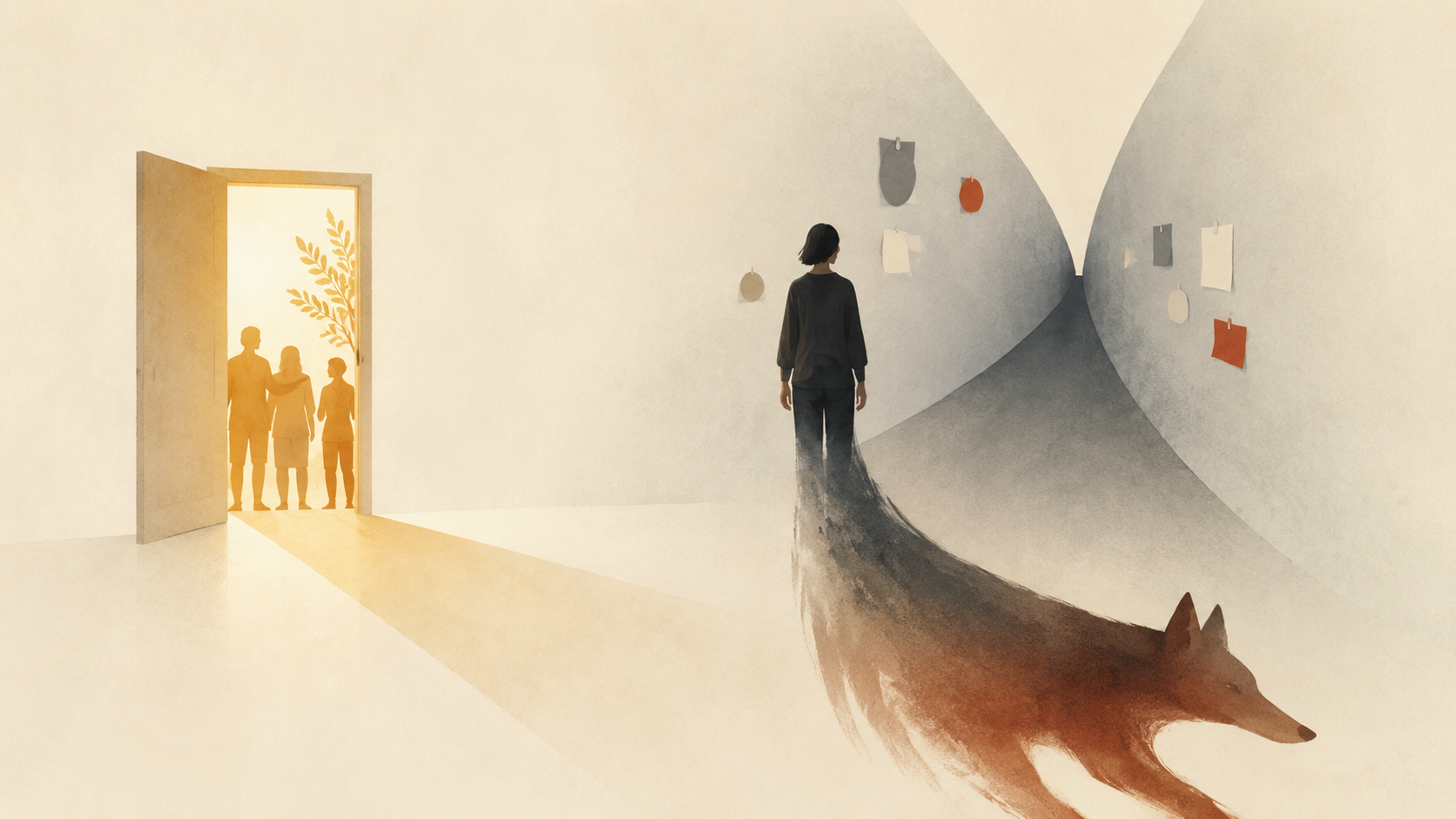
Coercive control rarely looks like control. On hidden Family Rules, the invisible leash, and why shouting at someone you love only ever makes it worse.
I lost a friend this year, and he isn’t dead.
I’ve known this man for over fifty years. Fifty years! In all that time he was never what you’d call a “things” person. Never chasing the car or the watch or the bigger house. He was the one at the end of the table making everybody laugh, the one who’d drive an hour to help you move a wardrobe and refuse the petrol money.
Then he met somebody. And piece by piece, over about three years, he has gone.
His four children — no contact. His brothers and sisters — no contact. His friends, me included — nothing. And all of us are on the outside now, scratching our heads, asking the same useless question at every christening and every funeral. What on earth happened to him?
I want to answer that question properly, because it happened to my friend and it may well be happening to somebody you love. And the answer, I’m afraid, is not the one everybody reaches for.
The fox in the henhouse
You know what a fox does in a henhouse. It doesn’t take one bird and leave. It kills the lot.
And we tell ourselves a story about that, don’t we? The fox is wicked. The fox kills for sport. The fox is malice on four legs.
Except that isn’t what’s happening at all — and the truth turns out to be far more useful to us than the story.
Out in the open, a fox takes a single bird and the rest of the flock scatters into the hedges. One kill, job done, off home. Put those same birds inside a coop, however, and something quite different unfolds. They cannot get away. They panic. They flap. And every flap re-triggers the fox’s prey drive — again, and again, and again. The behaviour doesn’t stop because the fox has had enough. It stops when the movement stops.
Wildlife researchers call it surplus killing, and here is the detail that stopped me in my tracks: birds that stay still and stay high — up on the nesting shelves, out of reach — are frequently left alive. It is the movement of live prey in the immediate vicinity that drives the whole thing. The fox isn’t even being wasteful; it will bury what it can’t eat and come back for it later.
Read that again, and then think about a family trying to rescue somebody.
We were the flapping
I have watched my friend’s family flap. Good heavens, how we flapped!
The phone calls. The letters. The carefully worded emails that took four drafts. The ultimatums. The intervention that was going to sort it all out once and for all. The endless, useless, heartfelt can’t you SEE what she’s doing to you?
And every single flap made it worse. Every one.
Because every flap handed her exactly what she needed: proof. Look at them. Look how they’ve always hated me. Look how they won’t leave us in peace. We didn’t just fail to rescue him — we became the evidence for the case against us. We were the movement that kept the drive going, and we did it out of love, which is the cruellest part of the whole business.
That’s the first hard truth of this piece, so let me say it plainly. The fox is not the only thing in the henhouse. The flapping matters too.
What a Family Rule actually is
Now for the part I came here to give you, because the fox is only the wrapping.
In my work I call these things Family Rules: below-conscious instructions we absorbed so young, and so completely, that we no longer experience them as rules at all. We experience them as who we are.
Nobody sat you down and taught them. There was no lesson. A tired parent sighed in a particular way when you asked for something and a rule was written: don’t be a burden. A room went cold when you were angry and a rule was written: your feelings are dangerous. You kept the peace at seven years old, everybody relaxed, and a rule was written: your job is to agree.
That last one is my friend’s rule. I’d bet the house on it.
And the thing about a rule laid down that early is that it doesn’t feel like obedience from the inside. It feels like personality. It feels like I’m just easy-going. It feels like I don’t like conflict. It feels, above all, like a free choice — which is precisely why you cannot argue somebody out of it. How do you debate a rule that nobody can hear?
The lock and the key
Here’s what I see again and again in the consulting room. In relationships of this kind you will nearly always find two sets of rules that fit together like a lock and its key.
My friend runs one position: your rules for me, and none of mine for you. Whatever you say goes. Full stop, period, end of discussion. He has no terms, makes no demands, sets no boundary — because setting one would break the older rule underneath.
She runs the mirror image: no rules for me, and my rules for you. Do as I say, not as I do. What’s hers is hers and what’s his is negotiable.
Do you see how neatly those click together? That is not bad luck, and it certainly isn’t coincidence. The fox does not force a door. The fox finds a door that is already standing open — and my friend’s door has been open since roughly 1978, when a small boy worked out that peace could be bought by agreeing.
There are healthier positions, of course. My rules for me, your rules for you — two adults, two sets of terms, mutual respect. That’s the one we’re aiming for. And our rules, agreed between us — which is what a good marriage actually is, negotiated out loud and revisited when it stops working.
But notice: you can only occupy those positions if you’re allowed to have rules of your own. And an awful lot of people were quietly taught that they weren’t.
Why he isn’t choosing this
Has he done any of it deliberately? Consciously? Weighing up his children on one side and her on the other and picking her?
No. Not for a second. And if you take one thing from this piece, please take that.
What sits underneath a Family Rule is what I call an Emotional Memory Image — an EMI. It’s a below-conscious, multi-sensory snapshot laid down in a moment of stress: a face, a tone, a room, a split second of this is dangerous. It sits outside of language, and its entire job is to predict. Faster than thought it scans what’s in front of you for anything resembling that original moment, and it fires the old protection before your conscious mind is even invited to the meeting.
So when she goes quiet in the car, he is not calculating. He is seven, and the room has gone cold, and the rule fires: agree, and it’ll be alright. Thirty seconds later he’ll give you a perfectly reasonable adult explanation for why he can’t come to his daughter’s birthday — and he’ll believe it, because that’s what the conscious mind does. It writes plausible reasons for decisions it never actually made.
What this does to a body
This is not merely a sad story about a friendship. It shows up in tissue.
I set this out with Professor Mark Johnson in Frontiers in Pain Research in 2023, in a paper called “Hidden family rules: perspective on a dysfunctional paternalistic system and the persistence of pain.” The argument is straightforward enough: where a person lives under authoritarian rules they cannot question, the EMIs formed in that system keep the stress response chronically switched on — and pain that ought to have settled long ago instead becomes sticky. It stops responding to treatment, because the treatment is aimed at the tissue while the driver is a rule.
The following year, with Nazish Idrees Chaudhary and Curtis Nordstrom, I took it up a level in Frontiers in Psychology: “Folie et Société: eroding the body–mind relationship via dysfunctional paternalistic systems.” Folie à deux is the old psychiatric term for a delusion shared between two people — and that is a fair description of what a Your/No-My couple builds together. A private reality, agreed between them, in which everyone outside is the problem. Scale that up from the couple to the family, and from the family to the society, and you get the shared delusions we all recognise from history but somehow never recognise in the moment.
The body keeps paying the bill for all of it. Fibromyalgia. Chronic fatigue. Autoimmune flare-ups. Gut trouble that no scan explains. Undiagnosed trauma doesn’t stay in the mind, because it was never only in the mind.
Coercive control: the law got there before the psychology did
Something worth knowing, and worth saying to anyone who thinks coercive control is a soft or vague matter.
In England and Wales, controlling or coercive behaviour in an intimate or family relationship has been a criminal offence since section 76 of the Serious Crime Act 2015, carrying up to five years’ imprisonment — and since April 2023 it applies whether or not the couple live together. Read the prosecution guidance and the very first example listed is this: isolating a person from their friends and family.
Not shouting. Not hitting. Isolating. The thing everybody around my friend can see and nobody can prove.
How to spot the fox early
Not a checklist to weaponise — a set of things to notice. The pattern of coercive control is nearly always the same, and it is nearly always slow.
It starts with a comment rather than a command. A small, deniable observation about your sister, your oldest friend, your daughter’s husband. Then the cost of seeing people quietly rises: a sulk before, a row after, an atmosphere for two days either side, until it is simply easier not to go. Then the story shifts — your family have never accepted me — and every attempt to argue with it becomes fresh proof.
Meanwhile the terms are never symmetrical. Her friends are fine; his are a problem. Her family is close; his is toxic. Money moves one way. Plans are made and unmade at her convenience and at his cost.
And the tell that outsiders always miss: he defends it. Fluently, calmly, in language that doesn’t sound like his own. Nobody locked a gate. He simply stopped walking towards it — and then explained, quite sincerely, why he never wanted to go.
Inch by inch, word by word, moment by moment, until the whole world is one person wide.
If it’s someone you love
Get up on the perch and stay reachable. That’s it. That’s the strategy.
No ultimatums. No campaigns. No dossier of screenshots. No family summit where four people take it in turns to tell him the truth about his wife — I promise you that room has never once ended the way anybody hoped.
Instead: short, warm, regular, and utterly hookless. A birthday text. A note at Christmas. Thinking of you. Door’s open. Always. No need to reply. Nothing to argue with, nothing to report back, nothing that gives the fox a single flap to work with.
It feels like doing nothing. It is not nothing. You are being the one landmark that is still standing when the fog finally lifts — and the day that rule cracks, and it does crack, he will look up and need to find somebody there, calm, on the perch, who never made him grovel for it.
Keep the door open and keep the drama out of the doorway. That’s the whole job.
If it’s you
Then let me say this as gently as I know how. The fact that you can read this and feel something turn over in your stomach is not weakness — it’s the rule announcing itself. That’s the first crack, and it’s a good sign, not a shameful one.
You were never given the wrong effort. You have tried extremely hard, for years, to be good enough for a set of terms that were designed never to be met. You were given the wrong door.
And the way through is not to understand it better. Understanding is a conscious act and this was never written in words. What has to happen is that the image underneath gets interrupted — which takes seconds, not years, once you know where to look. That’s the work I call Split-Second Unlearning, and it’s what the whole of my practice, and the MindReset app, is built on.
If you’d like to begin, download MindReset free on Apple or Google and start with the Stress programme. It costs nothing, and it is the doorway: it begins clearing your mind’s eye, the space out in front of you where these images sit and predict. When you’re ready to go further, the rest of the programmes are there as an in-app purchase. And if you want the whole map of where these rules come from and how they scale from a kitchen table to a country, that’s Family Rules Okay, on my site and on Amazon.
No talking required. That’s rather the point.
If this is describing your own relationship, there are people who understand coercive control very well and will talk it through with you in complete confidence. In the UK, the National Domestic Abuse Helpline is free and open around the clock on 0808 2000 247.
References
- Hudson, M. & Johnson, M.I. (2023). Hidden family rules: perspective on a dysfunctional paternalistic system and the persistence of pain. Frontiers in Pain Research. https://doi.org/10.3389/fpain.2023.1303853
- Hudson, M., Chaudhary, N.I. & Nordstrom, C. (2024). Folie et Société: eroding the body–mind relationship via dysfunctional paternalistic systems. Frontiers in Psychology. https://doi.org/10.3389/fpsyg.2024.1324303
- Crown Prosecution Service. Controlling or Coercive Behaviour in an Intimate or Family Relationship (s.76, Serious Crime Act 2015).
Names and identifying details in this piece have been changed.