
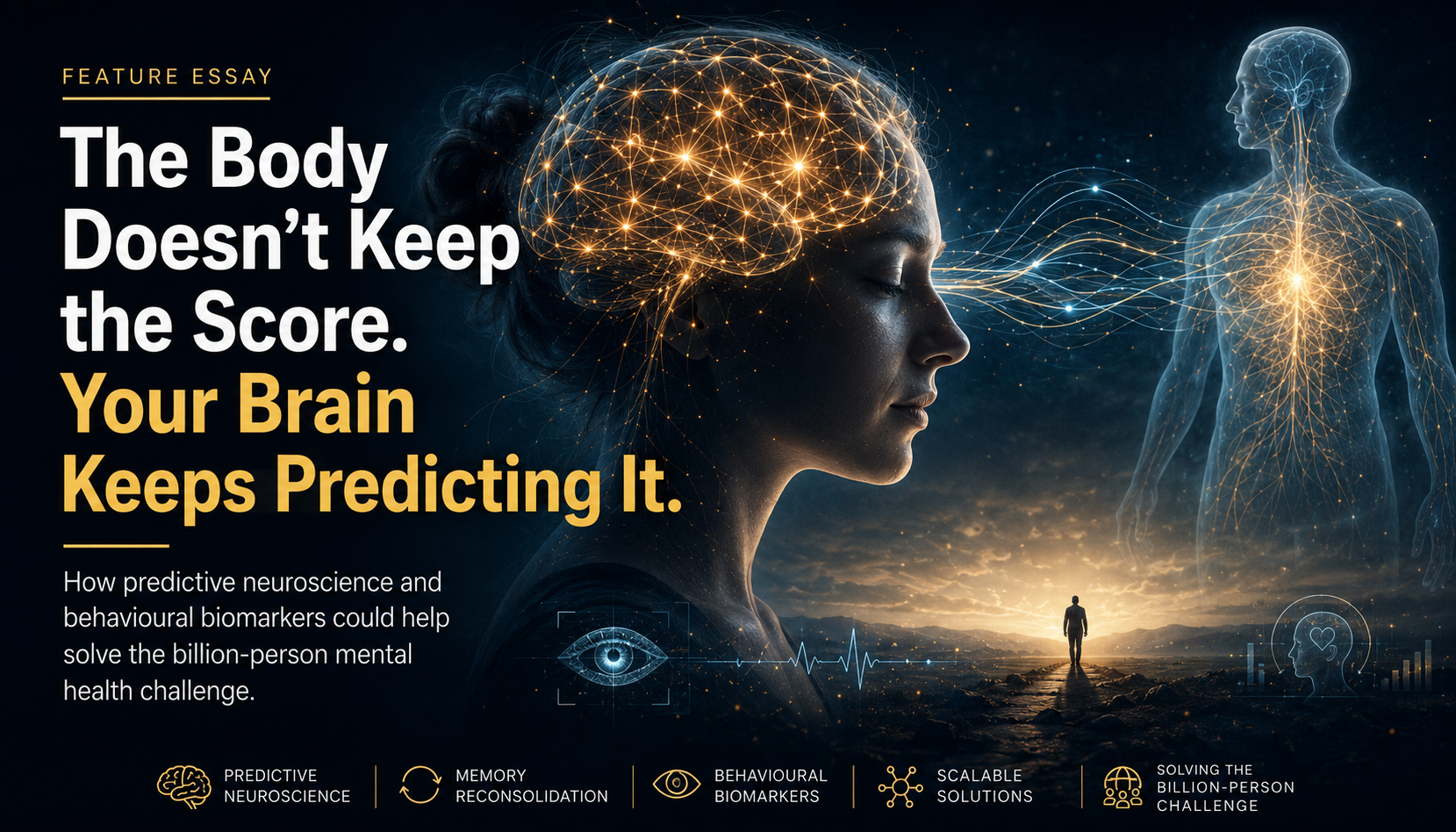
How predictive neuroscience and behavioural biomarkers could help solve the billion-person mental health challenge.
For more than a decade, one sentence has quietly shaped the way the world thinks about trauma.
The body keeps the score.
It has become more than the title of an influential book. It has become a cultural truth. Therapists repeat it. Doctors quote it. Clients recognise themselves in it. It helped transform public understanding by showing that trauma is not simply a distressing memory tucked away in the mind; it leaves measurable changes in physiology, behaviour and health.
That insight changed trauma care forever.
Before Bessel van der Kolk’s work reached a global audience, many people experiencing the long-term effects of trauma were still being told to “move on,” “let it go,” or “stop thinking about it.” The Body Keeps the Score challenged that misconception. It demonstrated that overwhelming experiences alter the brain, the autonomic nervous system, endocrine function, immunity and behaviour. Trauma was no longer viewed simply as a psychological event but as something that affects the whole person.
For that contribution, the field owes van der Kolk an enormous debt.
But science advances by refining ideas rather than protecting them.
Newton wasn’t rendered irrelevant by Einstein. Darwin wasn’t overturned by genetics. Their work became more precise as new evidence emerged. The same may now be true of trauma.
The question is no longer whether trauma affects the body.
The evidence overwhelmingly says it does.
The more interesting question is this:
Does the body actually keep the score?
Or has that powerful metaphor gradually become mistaken for a literal biological explanation?
A New Challenge to an Old Idea
Earlier this year, a group of neuroscientists led by Steven Kotler, Michael Mannino, Glenn Fox and Karl Friston posed precisely that question. Their argument was not that trauma fails to shape physiology—quite the opposite. Rather, they suggested that describing trauma as something stored in the body may no longer represent our best understanding of how the brain actually works.
That distinction matters.
Because where we believe trauma resides determines where we look for solutions.
If trauma is literally stored within bodily tissues, then recovery becomes an exercise in releasing what has been trapped.
If, however, trauma reflects the way the brain continually predicts danger, then the goal becomes something entirely different.
Not release.
Revision.
This may sound like a subtle change in language.
It isn’t.
It fundamentally alters how we think about healing.
The Brain Isn’t Watching Reality
Most of us grow up believing perception works rather like a video camera.
Something happens in the outside world.
Our senses detect it.
Our brain faithfully constructs a picture of reality.
Modern neuroscience suggests almost the reverse.
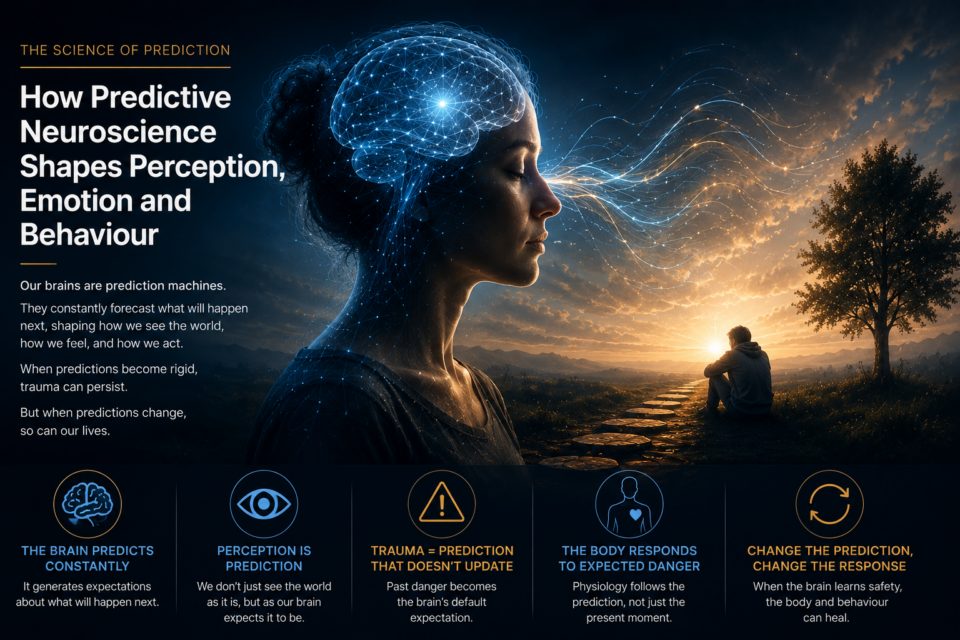
According to the theory of predictive processing, the brain does not passively wait for information to arrive. Instead, it continuously generates predictions about the world and compares incoming sensory information against those predictions (Friston, 2010; Parr et al., 2022).
In other words, your brain is constantly asking one question:
“What do I expect to happen next?”
Only when reality differs from that expectation does the brain need to update its internal model.
Anil Seth famously describes this as a controlled hallucination. Our experience of reality is not reality itself, but the brain’s best prediction of reality, continually corrected by incoming sensory information (Seth, 2021).
Think about walking through your own house at night.
You don’t consciously calculate where every chair, doorway or staircase is located.
You simply walk.
Your brain has already predicted the environment.
Only when someone leaves a suitcase in the hallway do you suddenly become aware of the prediction itself.
The pain comes from the collision.
The surprise comes from the prediction being wrong.
Normally the brain updates within seconds.
Trauma appears to be different.
When Yesterday Becomes Tomorrow
Imagine narrowly avoiding a serious car accident.
In an instant, your entire nervous system reorganises around survival.
Your pupils dilate.
Your breathing becomes shallow.
Your muscles prepare for action.
Stress hormones flood your bloodstream.
Attention narrows exclusively towards threat.
Everything your body does is intelligent.
Everything serves survival.
The difficulty begins when the prediction survives longer than the danger.
Weeks later, the sound of screeching tyres produces panic.
Years later, a raised voice feels life-threatening.
A harmless spider evokes overwhelming terror.
Walking into a crowded room triggers the same physiological response that once helped keep you alive.
From the outside these reactions appear irrational.
From the perspective of predictive neuroscience, they are entirely logical.
The body is not malfunctioning.
It is following instructions.
The brain still predicts danger.
The body simply obeys.
Seen this way, anxiety is no longer mysterious.
Hypervigilance is no longer irrational.
Panic is no longer weakness.
They are the predictable consequences of an internal model that has never successfully updated.
Information Doesn’t Care Where It Lives
This brings us to another scientific revolution that, at first glance, appears to have nothing whatsoever to do with trauma.
In 1948, Claude Shannon laid the foundations of modern information theory. His central insight was deceptively simple.
Information is independent of the medium that carries it (Shannon, 1948).
The same message can be spoken, written, transmitted by radio, stored on a hard drive or carried by light through fibre-optic cable.
The carrier changes.
The information does not.
Shannon wasn’t writing about psychology.
Yet his work raises an intriguing possibility.
If information itself is independent of the medium, should we automatically assume that emotional information must literally be stored inside muscles, fascia or organs?
Perhaps not.
The body undoubtedly expresses trauma.
It changes because of trauma.
But expression is not necessarily storage.
The body may instead be responding to informational processes generated by the brain’s predictive systems.
That possibility aligns remarkably well with active inference models, which propose that physiology is continually adjusted in anticipation of what the brain expects rather than simply reacting to what has already occurred (Barrett, 2017; Parr et al., 2022).
Beyond the Brain as a Filing Cabinet
For generations we imagined memory as something stored.
Experiences happened.
The brain filed them away.
Later, we retrieved them.
Increasingly, neuroscience paints a far more dynamic picture.
Remembering is not like opening a filing cabinet.
It is an act of reconstruction.
Every memory is rebuilt in the present rather than replayed exactly as it was originally experienced.
That makes trauma considerably more interesting.
Because perhaps what persists isn’t a memory at all.
Perhaps what persists is a prediction.
This is where the evolutionary biologist Richard Forsdyke offers an intriguing, if highly speculative, perspective. Forsdyke has argued that memory may be better understood as part of a distributed informational system rather than being confined exclusively to conventional neural storage. His “external memory” hypothesis remains well outside mainstream neuroscience, but it serves an important purpose.
It reminds us that the metaphors we inherit from one generation of science rarely survive unchanged into the next.
Whether Forsdyke’s model ultimately proves correct is almost secondary.
Its value lies in encouraging us to ask better questions.
A Clinical Observation
For more than twenty years I have been interested in one observation that repeatedly emerged during clinical work.
People almost always reacted before they knew why they were reacting.
Their eyes would briefly fix on a particular point.
Their breathing would pause.
Their facial muscles would tighten.
Their attention seemed to disappear somewhere beyond the immediate environment.
Only afterwards would they become consciously aware of fear, shame or anxiety.
It was as though the nervous system had already reached a conclusion before conscious awareness had even entered the conversation.
Those observations eventually led me to propose the concept of Emotional Memory Images (EMIs)—a working hypothesis suggesting that trauma may become organised around rapid, non-conscious emotional imagery that shapes predictions outside conscious awareness (Hudson et al., 2021; Hudson et al., 2022).
More recently, our work has begun exploring whether these predictive processes can be identified objectively through behavioural biomarkers and digital technologies capable of detecting subtle changes in eye movements, attention and physiological regulation before conscious awareness emerges (Hudson et al., 2025).
That progression—from clinical observation, to theoretical model, to measurable behavioural markers—is still in its early stages.
Like every scientific hypothesis, it must stand or fall on empirical evidence.
Yet predictive neuroscience offers something profoundly encouraging.
It provides a framework within which questions like these are no longer philosophical curiosities.
They become testable scientific hypotheses.
And if they prove to be correct, they raise an extraordinary possibility.
Perhaps trauma is not something the body keeps.
Perhaps it is something the brain continues to predict.
If that is true, then recovery may not require endlessly revisiting the past.
It may require helping the brain discover that yesterday is no longer happening today.
In the next section, we’ll explore how predictive processing, memory reconsolidation, metastability and behavioural flexibility are beginning to reshape trauma science—and why they may hold important clues to one of the greatest public health challenges of our time: helping more than one billion people worldwide living with mental health conditions receive effective, scalable care.
When the Prediction Becomes the Prison
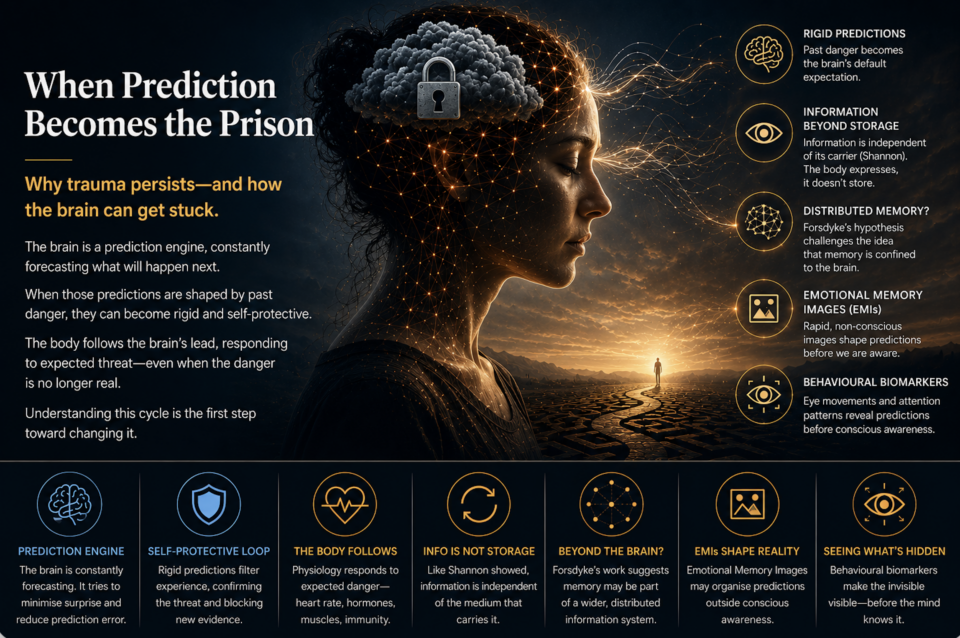
If the brain is fundamentally a prediction engine, then trauma begins to look very different.
It is no longer simply a memory that refuses to fade.
It becomes a prediction that refuses to change.
That distinction is subtle, but it has profound implications.
For decades, psychologists have tended to think of memory as something that is encoded, stored and later retrieved. Modern neuroscience paints a far more dynamic picture. Every act of remembering is also an act of reconstruction. The brain continually updates its internal model of the world in response to new evidence. We are not replaying the past so much as rebuilding it.
Most of the time, that flexibility is one of our greatest strengths.
Trauma appears to be one of the circumstances in which it breaks down.
When the Brain Stops Learning
Imagine touching a hot stove as a child.
Your brain learns something immediately.
Hot surfaces burn.
The prediction changes.
The next time you approach a stove, your behaviour has already adapted.
That is learning exactly as evolution intended.
Now imagine a child who grows up in an unpredictable or abusive environment.
The lesson is very different.
People cannot be trusted.
Anger means danger.
Being seen is unsafe.
Love disappears.
Unlike the hot stove, these predictions are far more difficult to test objectively. Every new experience is filtered through expectations that were once adaptive but may no longer reflect reality.
The prediction becomes self-protective.
And because it is self-protective, it becomes increasingly resistant to change.
This is one reason trauma can feel so enduring.
The nervous system isn’t refusing to learn.
It believes it has already learned the most important lesson of all.
Prediction Errors: The Engine of Change
Karl Friston’s theory of active inference proposes that the brain continually attempts to minimise prediction error (Friston, 2010; Parr et al., 2022).
Contrary to popular belief, the brain is not trying to perceive reality perfectly.
It is trying to reduce surprise.
Whenever incoming sensory information differs from expectation, one of two things can happen.
The brain can change the world to fit its prediction.
Or it can change the prediction to fit the world.
Healthy brains do both remarkably well.
Traumatised brains often struggle with the second.
If someone has learned that relationships are dangerous, they may unconsciously avoid intimacy.
If they expect rejection, they notice rejection everywhere.
If they predict humiliation, neutral expressions suddenly appear critical.
The prediction protects itself.
Every piece of evidence becomes another reason to believe it.
From the outside this looks like irrational behaviour.
From the inside it is simply the brain doing exactly what it evolved to do.
The Flexible Brain
One of the most exciting developments in contemporary neuroscience concerns a property known as metastability.
Healthy brains are not static.
They move effortlessly between curiosity and concentration, vigilance and rest, emotion and reflection. Networks continually reorganise themselves according to changing demands.
Flexibility is health.
Rigidity is often pathology.
Research increasingly suggests that trauma reduces this flexibility. Instead of moving fluidly between neural states, the brain becomes trapped in defensive attractor states characterised by hypervigilance, avoidance, rumination and freeze responses.
Importantly, this does not mean the brain is damaged.
It means the brain has become overly certain.
Its predictions have become so precise that contradictory evidence struggles to gain entry.
The world keeps changing.
The prediction does not.
Why the Body Follows
This brings us back to the body.
Trauma undeniably affects physiology.
The autonomic nervous system changes.
The hypothalamic-pituitary-adrenal (HPA) axis becomes dysregulated.
Inflammatory processes may increase.
Sleep alters.
Pain thresholds change.
Digestive function changes.
None of this is controversial.
What predictive neuroscience asks us to reconsider is why these changes occur.
The traditional interpretation is that the body stores trauma.
An equally plausible interpretation is that the body continually responds to what the brain predicts.
The heart accelerates because danger is expected.
Muscles tense because action is anticipated.
Cortisol rises because survival is being prioritised.
The body is not independently remembering the past.
It is faithfully implementing the brain’s best prediction of the future.
Seen this way, physiology becomes less like an archive and more like an orchestra performing from a score written elsewhere.
Shannon’s Information Revolution
At first glance, information theory seems an unlikely companion to trauma science.
Yet Claude Shannon’s work quietly changed the modern world.
His central insight was elegantly simple.
Information exists independently of the medium through which it travels (Shannon, 1948).
The words you are reading now could be spoken aloud, printed on paper, transmitted by radio waves or encoded as binary inside a computer.
The medium changes.
The information remains the same.
Shannon’s theory was never intended to explain memory.
Nevertheless, it raises an intriguing question.
If information is independent of its carrier, should we automatically assume that emotional information must reside inside tissue?
Perhaps the body’s role is not to store emotional information but to express the consequences of information held within predictive systems.
That distinction may appear philosophical. In reality, it changes where we direct our scientific attention.
Beyond Storage
The evolutionary biologist Donald Forsdyke has spent many years questioning whether conventional storage metaphors adequately explain memory.
His proposal—that memory may involve distributed informational architectures extending beyond traditional neural storage—is controversial and remains outside mainstream neuroscience (Forsdyke, 2015).
It is important not to overstate the evidence.
There is currently no consensus that memories literally exist outside the brain.
Nevertheless, Forsdyke’s work performs an important intellectual service.
It reminds us that science advances by questioning assumptions that once appeared obvious.
For centuries we believed memory had to occupy a physical location.
Perhaps that assumption itself deserves scrutiny.
Whether future neuroscience ultimately supports or rejects Forsdyke’s ideas is less important than the broader principle they illustrate.
Information may be considerably more dynamic than our current metaphors allow.
Emotional Memory Images Revisited
These ideas inevitably brought me back to a question that had puzzled me throughout my clinical work.
What exactly is the brain predicting?
When clients became anxious, something almost always happened before conscious thought.
Their eyes shifted.
Breathing altered.
Attention fixed somewhere just beyond immediate awareness.
Only afterwards did emotion emerge.
Those observations formed the basis of the Emotional Memory Image hypothesis (Hudson et al., 2021; Hudson et al., 2022).
The proposal is intentionally modest.
Rather than suggesting that trauma is stored as fixed bodily memory, EMIs propose that rapid, non-conscious emotional imagery may organise predictions about safety before conscious awareness has time to interpret events.
Whether this hypothesis ultimately proves correct remains an empirical question.
What matters is that predictive neuroscience now offers methods capable of testing such ideas rather than simply debating them philosophically.
Recent developments in behavioural biomarker research, eye tracking and digital public health technologies have begun making these previously invisible processes measurable (Hudson et al., 2025).
For the first time, we may be approaching a point where the earliest moments of the stress response can be observed objectively rather than inferred retrospectively.
If so, the implications extend well beyond theory.
They begin to change how we detect trauma, how we understand recovery and, perhaps most importantly, how we scale effective interventions.
In the final part, we’ll explore what this means for therapy, why memory reconsolidation may be one of the most important discoveries in modern psychology, and how these developments could contribute to solving what the World Health Organization has described as one of the defining public health challenges of our time.
From Prediction to Possibility
If predictive neuroscience is pointing us in the right direction, then an obvious question follows.
How do we help the brain change its predictions?
For decades, trauma therapies have approached this question from different directions.
Some encourage people to revisit painful memories through detailed narrative. Others focus on bodily awareness, emotional processing, cognitive restructuring or behavioural exposure. Although these approaches differ in technique, many share an underlying goal: to reduce the influence of the past on the present.
Predictive neuroscience suggests they may also share something deeper.
Perhaps effective therapy is not removing trauma from the body.
Perhaps it is helping the brain discover that its prediction is no longer true.
That shift may sound almost semantic.
In reality, it changes the target of treatment entirely.
The Brain Learns Through Surprise
One of the most important discoveries in contemporary neuroscience is that memories are not permanently fixed.
When a memory is reactivated, it briefly becomes unstable before being stored again. During this period—known as memory reconsolidation—new information can modify what is learned (Nader et al., 2000; Monfils et al., 2009; Ecker et al., 2022).
This is profoundly different from the older idea of simply retrieving a memory from storage.
Instead, remembering becomes an opportunity for updating.
Seen through the lens of predictive processing, this makes perfect sense.
If the brain predicts danger and, during that prediction, experiences convincing evidence of safety, the prediction itself can begin to change.
Learning is not driven by repetition alone.
Learning is driven by violated expectation.
The nervous system does not merely remember.
It recalibrates.
Why Eye Movements Matter
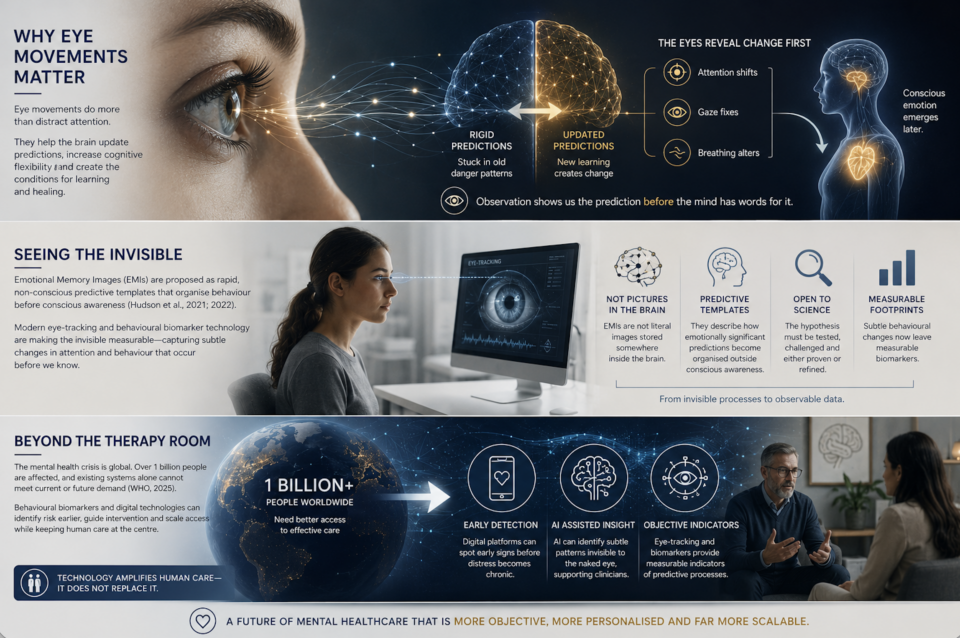
This is one reason therapies involving eye movements continue to attract scientific interest.
Eye Movement Desensitisation and Reprocessing (EMDR) has accumulated substantial evidence for treating post-traumatic stress disorder, although debate continues regarding its precise mechanisms.
One possibility is that eye movements facilitate the updating of predictive models while traumatic memories remain active.
Another is that they temporarily increase cognitive flexibility, allowing rigid predictions to become more open to revision.
Whatever the precise explanation proves to be, eye movements appear to be doing considerably more than distracting attention.
They seem to create conditions in which learning becomes possible.
That observation resonated deeply with my own clinical experience.
Long before I developed the EMI hypothesis, I had become fascinated by the fact that people’s eyes frequently revealed changes before they themselves became aware of emotional change.
Their attention shifted.
Their gaze fixed.
Their breathing altered.
Only afterwards did conscious emotion emerge.
It was as though the eyes were quietly revealing the prediction before the mind had found words to describe it.
Seeing the Invisible
Those observations eventually led to the proposal that Emotional Memory Images may function as rapid, non-conscious predictive templates that organise behaviour before conscious awareness has time to interpret events (Hudson et al., 2021; Hudson et al., 2022).
Importantly, EMIs are not proposed as literal pictures stored somewhere inside the brain.
Rather, they represent an attempt to describe how emotionally significant predictions might become organised in ways that remain largely inaccessible to conscious reflection while exerting powerful influence over physiology and behaviour.
Whether that hypothesis ultimately survives scientific scrutiny remains an open question.
It should.
Science advances by testing ideas rather than protecting them.
What excites me is not that EMIs might be right.
What excites me is that they can now be investigated.
Recent developments in digital health, behavioural biomarker analysis and eye-tracking technology have made it increasingly possible to observe subtle changes in attention and behaviour that occur before conscious awareness (Hudson et al., 2025).
Processes that were once invisible are beginning to leave measurable footprints.
That represents an important shift.
For decades we relied almost entirely upon what people could tell us.
Increasingly, we can begin asking what their behaviour is already showing us.
Beyond the Therapy Room
This matters for reasons extending well beyond individual psychotherapy.
In 2025, the World Health Organization estimated that more than one billion people worldwide are living with mental health conditions while highlighting profound gaps in access to effective care. The report concluded that existing systems alone cannot meet current and future demand. New approaches are urgently required.
That challenge is difficult to ignore.
Traditional psychological services remain essential.
Yet they are labour-intensive, expensive and impossible to scale sufficiently to meet global need.
If predictive processes can be identified objectively through behavioural biomarkers, opportunities begin to emerge that were unimaginable only a few years ago.
Digital platforms may be capable of detecting the earliest signs of maladaptive stress responses before distress becomes chronic.
Artificial intelligence may assist clinicians by recognising subtle behavioural patterns invisible to the naked eye.
Eye-tracking technologies may eventually provide objective indicators of predictive processes that currently rely upon subjective report.
None of these developments replace compassionate human care.
Nor should they.
Instead, they may allow clinicians to spend more time doing what only humans can do while technology helps identify where intervention is most needed.
That possibility formed the basis of our recent work exploring behavioural biomarkers and scalable digital approaches to stress-response regulation (Hudson et al., 2025).
Whether this particular pathway proves successful remains to be determined.
But the direction of travel feels increasingly clear.
The future of mental healthcare is likely to become more objective, more personalised and considerably more scalable than anything we have known before.
A New Conversation About Trauma
Perhaps the greatest contribution of The Body Keeps the Score was not its explanation of trauma.
Perhaps it was its insistence that trauma deserves to be understood at all.
Without that shift in thinking, many of the questions now emerging within predictive neuroscience might never have been asked.
The next step is not to reject that legacy.
It is to refine it.
The body undoubtedly expresses trauma.
It reflects trauma.
It adapts because of trauma.
But whether it literally stores trauma remains an open scientific question.
Increasingly, contemporary neuroscience points towards a more dynamic explanation.
The brain continuously predicts.
The body continuously prepares.
Experience continuously updates those predictions—or, sometimes, fails to.
When prediction becomes trapped, physiology follows.
When prediction changes, physiology often changes with it.
The Next Frontier
Every significant scientific advance begins with someone asking a slightly different question.
For centuries, medicine has asked where disease resides.
Perhaps trauma science now needs to ask something else.
What is the brain predicting?
If maladaptive predictions can be identified objectively…
If they can be updated safely…
If behavioural biomarkers can detect them before suffering becomes entrenched…
…then we move beyond simply describing trauma.
We begin understanding its underlying dynamics.
That has implications not only for therapy, but for public health.
The World Health Organization has made it clear that the scale of the global mental health crisis demands innovation as well as compassion.
One billion people cannot be reached by doing more of the same.
They require approaches that are evidence-based, measurable and scalable.
Predictive neuroscience offers one promising direction.
Behavioural biomarkers may offer another.
My own work on Emotional Memory Images represents an attempt to explore where those two paths meet.
Whether the hypothesis ultimately stands or falls is for science—not opinion—to determine.
That is exactly as it should be.
But if the emerging evidence continues pointing in this direction, then perhaps we need to rethink one of the most influential ideas in modern trauma psychology.
Perhaps the body doesn’t keep the score.
Perhaps the brain keeps predicting it.
And perhaps healing begins the moment that prediction finally changes.
References
Barrett, L. F. (2017). The theory of constructed emotion: An active inference account of interoception and categorization. Social Cognitive and Affective Neuroscience, 12(1), 1–23.
Damasio, A. R. (1994). Descartes’ error: Emotion, reason, and the human brain. Putnam.
Damasio, A. R. (1999). The feeling of what happens: Body and emotion in the making of consciousness. Harcourt.
Ecker, B., Ticic, R., & Hulley, L. (2022). Unlocking the emotional brain (2nd ed.). Routledge.
Forsdyke, D. R. (2015). Memory pavilions: Memes, genes, and the architecture of ideas. Aporia Press.
Friston, K. (2010). The free-energy principle: A unified brain theory? Nature Reviews Neuroscience, 11(2), 127–138.
Hudson, M., et al. (2021). Emotional Memory Images: Theory and clinical implications. Frontiers in Psychology. https://doi.org/10.3389/fpsyg.2021.716535
Hudson, M., et al. (2022). Emotional Memory Images and the persistence of the stress response. Frontiers in Psychology. https://doi.org/10.3389/fpsyg.2022.947952
Hudson, M., et al. (2025). Behavioural biomarkers and scalable stress-response regulation using digital technologies. Computers in Human Behavior: Artificial Humans. https://doi.org/10.1016/j.chbah.2025.100185
Monfils, M.-H., Cowansage, K. K., Klann, E., & LeDoux, J. E. (2009). Extinction-reconsolidation boundaries: Key to persistent attenuation of fear memories. Science, 324(5929), 951–955.
Nader, K., Schafe, G. E., & LeDoux, J. E. (2000). Fear memories require protein synthesis in the amygdala for reconsolidation after retrieval. Nature, 406, 722–726.
Parr, T., Pezzulo, G., & Friston, K. J. (2022). Active inference: The free energy principle in mind, brain, and behavior. MIT Press.
Seth, A. (2021). Being you: A new science of consciousness. Faber & Faber.
Shannon, C. E. (1948). A mathematical theory of communication. Bell System Technical Journal, 27(3), 379–423.
van der Kolk, B. A. (2014). The body keeps the score. Viking.
Read next: the MindReset app, the External Screen Model and Beyond the cell.