

Freedom To… Be Analogue
Can I ask you something before we start? When did you last hear the voice of the person you text most?
Not read them. Hear them. The intake of breath before they answer. The little laugh they do when they’re about to disagree with you. The pause that tells you more than the sentence that follows it.
If you had to think about it, you’re not alone. Let me tell you about a phone call.
The wrong number
A friend of mine was telling me about her mum. Her dad had died eleven months earlier after a long illness, the kind that empties a house slowly and then all at once. Six months after the funeral, her mum had her hip replaced. Routine, they said. Except the wound wouldn’t heal. Month after month, dressings and district nurses and “give it time,” and the skin simply refused to knit.
I’d never met her mum. So I asked my friend for her phone number, and I asked her to say nothing to her mother about our conversation. Nothing at all.
Later that day I rang. When she answered, I asked, “Is Jan there?”
“I think you’ve got the wrong number, love.”
“Oh… I’m so sorry. Have I? I was sure this was the right one.” And we were off. I didn’t hang up, and neither did she. We talked for the best part of an hour. About nothing, really. The weather, the price of things, where she’d lived, a story about a dog. I never mentioned her husband. I never mentioned her hip. I was just a stranger on the end of a telephone who had time, who laughed in the right places, and who let the pauses be pauses.
Two days later my friend rang me. Her mum was still talking about the call. “Some chap rang for a Jan, and do you know, we chatted for nearly an hour!” One week later, the wound had knitted together.
Now, I can’t prove that a phone call healed a hip, and I wouldn’t try to. Wounds heal for all sorts of reasons and I’m not her doctor. But I can tell you what a body does when it finally stops bracing, because I’ve watched it happen in my clinic for a very long time, and I can tell you why I made that call in the first place. That’s what this piece is about. (Names and details changed, as always.)
We are running out of words
The reason I made the call is in a magazine article I read the weekend before, and underlined twice.
Two psychologists, Valeria Pfeifer and Matthias Mehl, have been quietly counting how much we actually talk. In 2005, the average person spoke around 16,632 words a day. By 2019 it was about 11,900. That’s a drop of twenty-eight per cent. Put simply, every year we each say roughly 338 fewer words out loud than we did the year before, and it has been going on for two decades.
Here’s the part that stopped me. It isn’t the big conversations that are going. You still talk to your partner. You still ring your mum on a Sunday. What’s disappearing is the small stuff. The two sentences with the woman at the till. The “dreadful, isn’t it?” at the bus stop. The stranger on the train who notices your book. Mehl calls these “micro-opportunities for belonging,” and they are being deleted from our days without anyone ever deciding to delete them.
Why does that matter? Because of what those small conversations do to your body. Robert Waldinger, who runs the Harvard study that has followed people’s lives for over eighty years, says that a positive exchange with a stranger does something very specific: it tells our bodies that we are safe, and our physical arousal drops. Read that again. Not our minds. Our bodies. A kind word at the till isn’t a nicety. It’s a signal to your nervous system that the alarm can stand down.
And my friend’s mum hadn’t had that signal in a year.
The parts they decided you wouldn’t miss
Let me give you a picture to hold on to.
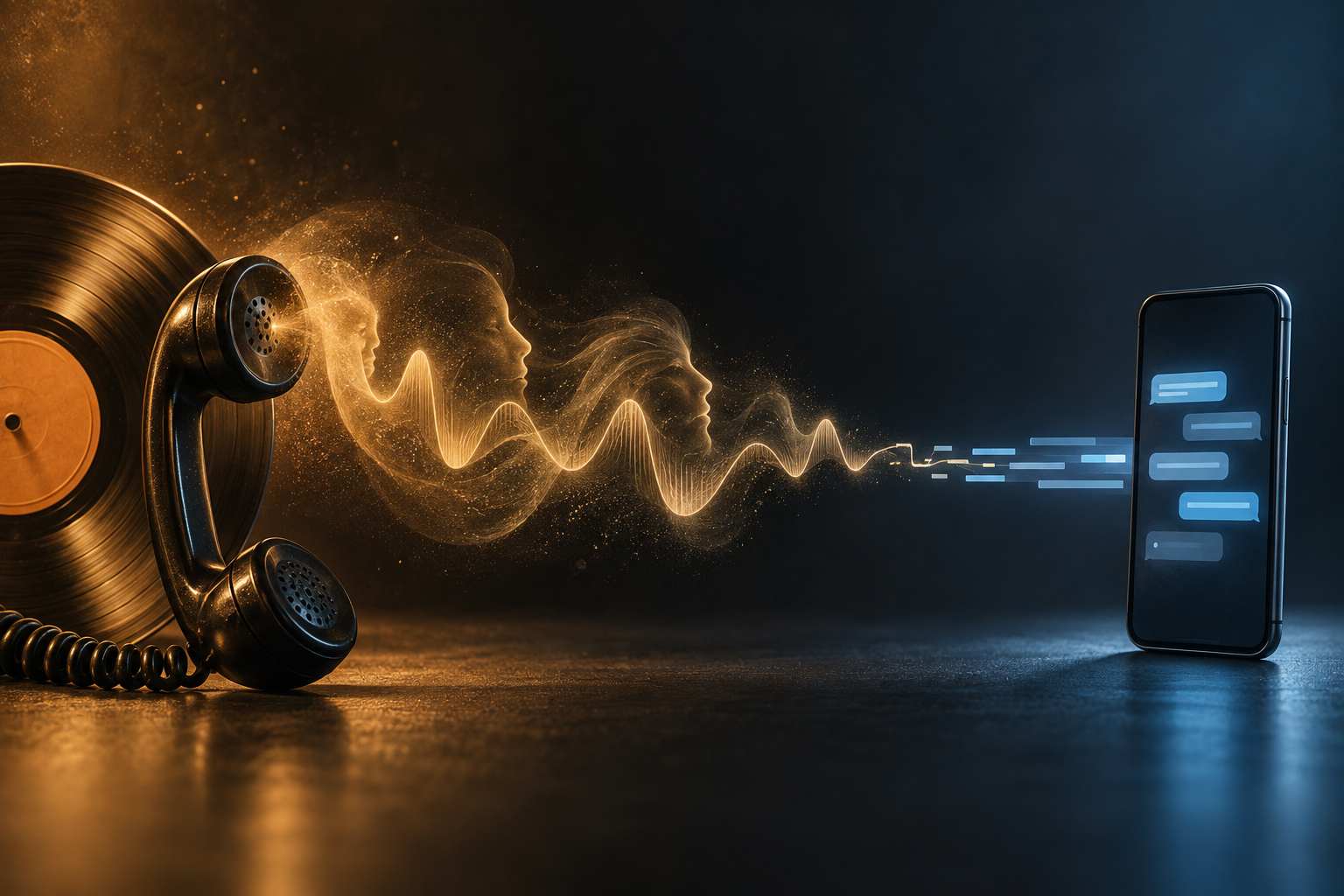
Do you remember when the MP3 arrived? Music in your pocket, thousands of songs, instant. It was a miracle. What nobody mentioned at the time was how they’d made the files so small. An MP3 works by throwing away the parts of the sound that a computer model decided you wouldn’t notice. The very top of the cymbal. The room around the singer’s voice. The breath before the note. A system deciding, on your behalf, which parts of the signal were surplus to requirements.
And what happened next? People started paying good money for vinyl again. Not out of nostalgia, whatever the marketing says. They’re buying back the “imperfections”… the crackle, the warmth, the air around the instruments. It turns out the noise was part of the connection.
Now look at your phone. A text arrives with no face, no tone, no breath, no pause. A voice note has the tone but not the eyes. A video call has the eyes but not the room, and not the tiny shift a face makes a fraction of a second before the words arrive. The scientist Robin Dunbar, who has spent his career studying friendship, says it’s exactly these visual and vocal cues that hold a relationship together. And they are precisely what got compressed out. We have been handed the MP3 of human relationship and told it’s the real thing.
Your body, like the vinyl buyer, knows the difference. It just doesn’t have the words for it.
Where does a conversation actually happen?
Here’s a question I ask in my clinic, and I’d like you to try it now. Think of someone you love talking to. Where, in space, does that conversation happen?
Most people point straight in front of themselves, somewhere between their own chest and the other person’s face. That’s not a figure of speech. Your brain keeps a separate map of the arm’s-length space in front of you, the space where you can be touched, handed something, hugged or hit. Your nervous system watches it like a hawk, because for most of human history what came into that space could feed you or kill you.
My work, in the clinic and in the research I’ve published, is about what else lives in that space. When something frightening happens, especially when we’re young, the body takes a kind of snapshot of the moment and leaves it hanging out there in front of us. We don’t see it consciously. But the body does, and it reacts to it, every day, as if the moment were still happening. The jaw tightens. The breath goes shallow. The gut shuts its doors. We call it “just how I am,” or an anxious stomach, or a shoulder that never quite lets go.
Now put the two ideas together, because this is the whole piece really.
When a real person stands in that space and their face stays open, the old snapshot gets contradicted, live, faster than thought. The alarm says danger; the face in front of you says no, look, safe; and the body, which trusts a real face over any argument you could make it, quietly updates. That is what Waldinger is measuring when a stranger’s kindness lowers someone’s arousal. That is what belonging is, physically. A picture being overwritten by a person.
A screen never enters that space. The phone sits at the very edge of your bubble, and the person “in” it is not in the room, not available to your body at all. So the old picture never gets contradicted. It just sits there, running the same prediction, day after day. Which is why someone can have five hundred contacts, a full inbox and a phone that never stops… and a nervous system that has not once, in months, been told that it’s alright.
The hum you can’t name
I write the word dis-ease with a hyphen on purpose. Long before anything has a name, long before a doctor can find it on a scan, a whole system can be ill at ease. A body built for faces and pauses and the smell of someone’s coat is being fed a compressed signal, and it registers the difference as a low hum of unease it can’t explain. Restlessness. Tiredness that sleep doesn’t fix. Irritability with the people you love. A drawer full of normal test results and a body that disagrees.
Is that all in your head? No, and I want to be clear about that. The tight chest is real. The gut is real. The wound that won’t heal is real. Keep seeing your doctor. What I’m offering isn’t an alternative to medicine but an answer to a question medicine doesn’t usually ask: not “what’s wrong with you?” but “what’s missing from around you?”
Think about my friend’s mum again. In the space of a year, the husband whose voice had filled the house was gone, the visitors had thinned as they do, and the hip had kept her in. Her body had been running one message, you are alone, this is not safe, for months. And a body that believes it isn’t safe does not spend its resources on knitting skin. Why would it? It’s braced for something worse.
Then a stranger’s voice, live, unhurried, real, was in her ear for an hour. Nobody explained anything to her. She didn’t need to know why I’d rung. Her body was simply told something different, and it stood down and got on with the job it had been too frightened to do.
And notice, it was a phone call, not a face. So I’m not telling you the phone is the villain. A live voice still carries the pause, the breath, the laugh that arrives a beat too early. The face is best. The voice is next. The text is the MP3.
The sentence you were never allowed to finish
There’s one more layer, and it’s the one that stops people picking up the phone.
Every family runs on rules nobody says out loud. Don’t make a fuss. Don’t start. Wait to be spoken to. They’re learned in childhood, by a child simply trying to stay safe, and they run for decades. A rule you were never allowed to break has to live somewhere, and if it can’t live in your mouth, it lives in your body.
And where would a person practise breaking a rule like don’t start? Not in the big conversations, where the stakes are high and the rule is strongest. In the small ones. At the till. On the platform. With the man walking the dog. The incidental conversation is the training ground, the low-stakes place where you find out, three hundred times over, that the world does not punish you for opening your mouth. And that training ground is closing at 338 words a year.
Freedom To… Be Analogue
Nobody forced us down the digital pathway. We were herded there, gently, by convenience: the self-checkout that saves you a sentence, the app that saves you a phone call, the delivery that saves you the walk to the shop and the two people you’d have nodded to on the way. Each one felt like freedom. Added together, they have quietly taken something you didn’t know you’d agreed to give.
Being analogue isn’t about throwing your phone in the sea. I use mine all day; you’re probably reading this on yours. It’s about noticing that a digital relationship is off/on, a switch, and a real one has depth and breadth, and that your body has only ever been fed by the second kind. It’s about choosing, on purpose, to walk back into the space in front of other people and let your nervous system do what it has always done there.
Which brings me to the question that has sat with me since I put that magazine down. Without language, and without the skills to communicate, what will become of us? Loneliness looks set to overtake us, and it won’t announce itself. It will arrive the way that woman’s wound did: quietly, one unhealed thing at a time.
If you’ve a drawer full of normal results and a body that disagrees, and you’d like help finding where the old alarm sits and letting it go, that’s what the Stress programme in my MindReset app is for. It’s on Apple and Google. Please use it alongside your doctor, not instead of them, and if what’s underneath turns out to be heavy, do this work with someone qualified sitting beside you.
But the first step doesn’t need an app. It needs ten minutes.
Do this before you close the page
Pick up your phone. Find the person you text most. Don’t text them. Ring them.
I know. You’ve already got three reasons why not: they’ll be busy, it’ll be weird, you’ll do it later. That’s the old rule talking. Ring them anyway. Say “I just wanted to hear your voice.” Then notice what your body does in the first ten seconds of hearing theirs. That drop in the shoulders? That’s the whole of this article in one breath.
And tomorrow, spend a few of your 338 words on a stranger. Headphones off at the till. One sentence at the bus stop. You’ll feel silly for about a week. Then you’ll start to feel something else, and I’d like you to pay attention to what it is.
I’ve spent my life reading faces, because I was born conductively deaf and had to. It’s taught me that what you’re craving when you scroll and scroll and feel emptier with every swipe isn’t nostalgia and it isn’t weakness. It’s the bits the system removed. The pause. The breath. The face changing before the words arrive. They’re still there, at the till, on the platform, at the other end of the phone call you keep not making. They cost nothing, and they’re waiting in the space in front of you, where they’ve always been.
Go and get them back. Your body has been asking.
With love,
Matt xx
Someone to share this with: the person you only ever text. Send it to them, and then ring them.
The science behind this piece
Where do the “338 words a day” figures come from?
From research by Valeria Pfeifer and Matthias Mehl, reported in the Telegraph Magazine on 12 September 2026. Daily spoken words fell from about 16,632 in 2005 to about 11,900 in 2019, a 28 per cent drop, which averages out at roughly 338 fewer words a day each year. The Robert Waldinger and Robin Dunbar comments are from the same article.
What is the “snapshot” in the space in front of you?
In my research I call it an Emotional Memory Image, or EMI: a below-conscious image laid down in a moment of overwhelm that sits in the peripersonal space in front of a person and keeps triggering the body’s alarm long after the event. Because it is below conscious, you can’t simply “think of a time” and find it, which is why the “where?” question works better than the “what happened?” question. The theory is set out in Hudson, Frontiers in Psychology 2021 (doi 10.3389/fpsyg.2021.716535) and extended in Hudson, Frontiers in Psychology 2022 (doi 10.3389/fpsyg.2022.947952).
Are you saying memory isn’t in the brain?
I’m saying it isn’t only in the brain. Donald Forsdyke’s 2009 paper in the Journal of Theoretical Biology (doi 10.1016/j.jtbi.2009.01.028) made the case that memory may be stored outside the body, and Bruce Lipton has long argued that the cell membrane, not the nucleus, is where a cell’s “memory” sits. My work extends that outward, into the field around the body and the space in front of us, which is exactly where a real conversation happens and a screen never does.
Is this saying my symptoms are “all in my head”?
No. The opposite. The symptoms are real and physical; what I’m pointing at is where the alarm that drives them may be sitting. Keep seeing your doctor, and add this alongside.
Do I have to give up my phone?
No. Keep the phone. Just stop letting it be the only place your relationships live, and spend your 338 words a day on real faces.