
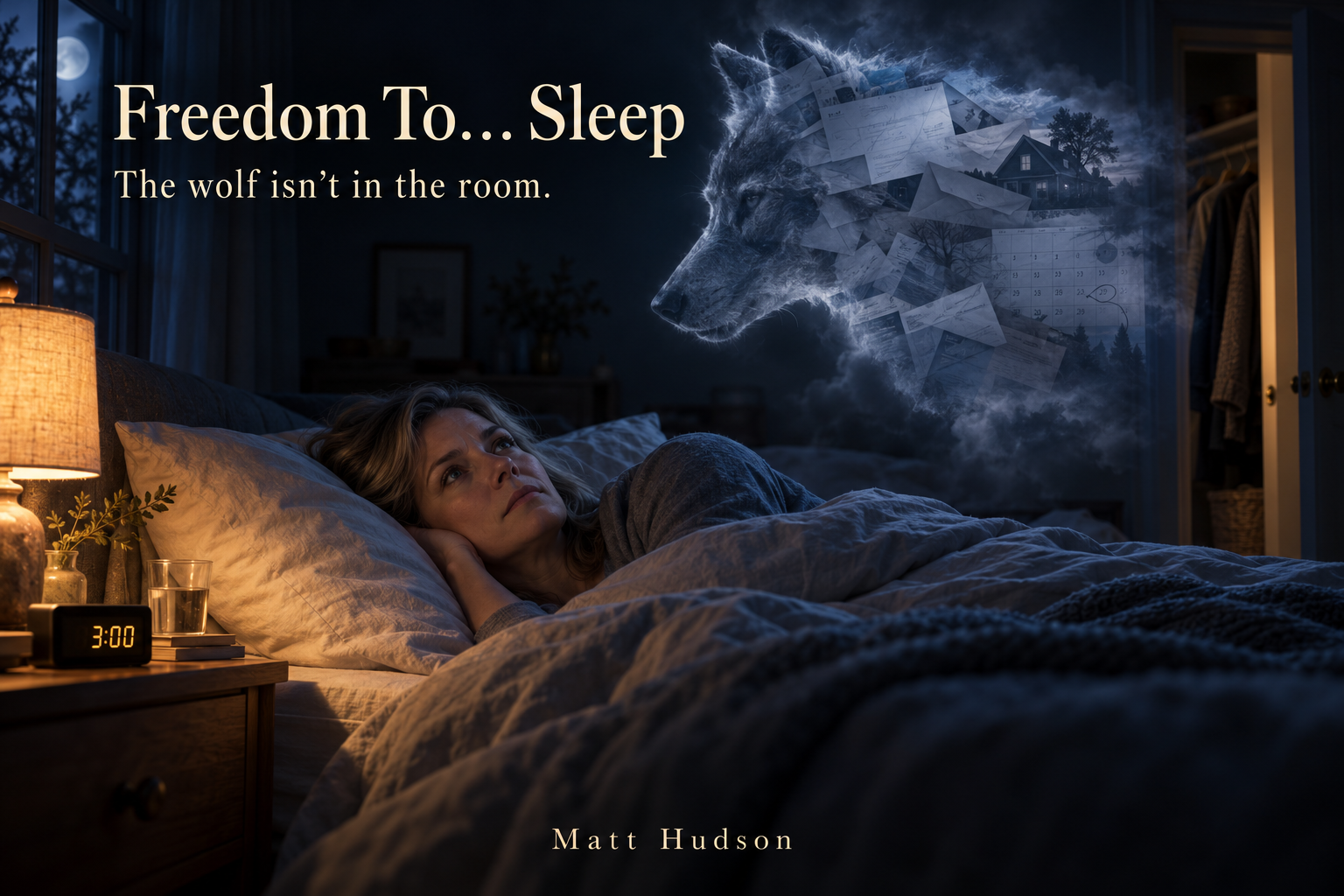
The Wolf That Isn’t in the Room
It’s 3am. The room is quiet. The door’s ajar, and your body is on watch – not for a wolf in the room, but for tomorrow: bills, savings, the job, the news. Knowing the wardrobe is empty doesn’t switch off the fear. Here’s the thing – it can’t. This piece explores why sleep breaks at night, how old pictures keep you awake, and simple ways to find rest again.
Key Takeaways:
- Waking at 3am is usually triggered by a threat in tomorrow – bills, jobs, news – not by anything in the room; knowing you’re safe doesn’t switch off the body’s alarm.
- Your body replays an Emotional Memory Image, like Avicenna’s lamb sensing a wolf it can’t see; old undiagnosed trauma makes tomorrow look like a familiar, frightening picture.
- When you wake, ask “if this feeling were out there, where would it be?” and simply notice it has a place; see a GP if sleeplessness persists for weeks.
The Threat in Tomorrow
You’re lying awake at 3am. Not because there’s a threat in the room. Because there’s a threat in tomorrow: bills, savings, the job, the news, distant wars. The room is quiet. The door’s locked. Everyone else is asleep. And your body is behaving like something terrible is happening.
You’re safe, and your heart is going like you’ve just sprinted for a train. That mismatch is the whole puzzle in one sentence. The alarm isn’t coming from the room. It’s coming from the calendar, the bank balance, the headlines you read before bed. Your night thoughts are doing a job that made sense a long time ago, and nobody told them the situation changed.
The Threat in Tomorrow, Not in the Room
At 3am, the threat your body registers isn’t a noise downstairs. It’s the unpaid bill, the shrinking savings, the job uncertainty, or a distant war scrolling across your phone. Psychologists call this cognitive arousal: the mind treats abstract worries as present dangers. The body can’t tell the difference between a wolf at the door and a mortgage due on Friday.
What does that look like in practice? The usual suspects, on repeat:
- Money: the card that might bounce, the rent that’s due, the savings that aren’t growing as fast as you’d like
- Work: the email you sent, the meeting tomorrow, the creeping sense the ground is shifting under your job
- The wider world: news headlines, wars, and the general dread of late night scrolling
- The smaller stuff that grows huge at 3am: a text you misread, a conversation you’re replaying for the fifth time
Your body floods you with alertness, but there’s nothing to actually do at 3am. You can’t pay a bill at 3am. You can’t solve a war. So the alertness turns in on itself and becomes insomnia thoughts, a loop that goes nowhere. Here’s a small tip: when you notice the spiral, ask yourself what the worry is actually about. It’s almost always tomorrow. Not now. Name the day it belongs to, and it loosens its grip a little.
Why Knowing the Wardrobe Is Empty Doesn’t Help
Adults who know the wardrobe is empty still can’t sleep with the door ajar. Because knowing and fear live in different places. You can be perfectly rational about the lack of monsters and still feel your skin crawl at the dark gap in the door. That gap is the whole problem in miniature.
The old writing on this is worth knowing. Avicenna described a sheep sensing a wolf even when kept in sight of it, and his writing on that reaction is close to what we’d now call an emotional memory image (EMI). Historians doubt the experiment ever happened, but the idea holds up: the body keeps urgent pictures out in front of us, in the space within reach. So when tomorrow lines up with an old picture (say, money rows at the kitchen table when you were a kid), your body keeps watch whether or not there’s anything to watch.
The practical takeaway matters more than the theory. Don’t try to argue yourself out of the fear at 3am. It won’t work. Instead, try this: when you wake, ask if this feeling were out there, where would it be? Then just notice that it has a place. You’re not solving it. You’re giving it coordinates so it stops feeling like it’s everywhere. That acknowledgement is not weakness, and it’s not a sign anything’s wrong with you. It’s normal. It’s human.
If the 3am waking drags on for weeks, see a GP. And if the night thoughts get genuinely dark, the Samaritans are on 116 123, any hour. There’s also a free Stress programme in the MindReset app if you want a structured way to work through it. Rest is allowed. You don’t have to fix tomorrow at 3am.
What Is an Emotional Memory Image – and Why Does Your Body Keep Showing You One?
An Emotional Memory Image (EMI) is the body’s way of keeping an urgent picture in front of you. Like a mental snapshot of a past threat that your system still treats as current. Think of it as a warning sign stapled to your brain, one you can’t quite pull down.
And these images aren’t random. Your body is trying to protect you by keeping the danger in sight. Within reach. Somewhere it can watch it.
That’s why the 3am thoughts feel so vivid and present. Your system has decided the threat needs monitoring. Even when there’s no wolf in the room.
Avicenna’s Lamb and the Wolf It Could Sense but Not See
Avicenna described a lamb kept in sight of a wolf. Historians doubt the experiment, and to be fair, it’s a strange one to picture. But his writing on a sheep sensing a wolf? That describes an Emotional Memory Image.
The lamb could sense the threat without ever seeing it. Its body reacted as if the wolf were right there, standing in the space within reach. The image did the work that eyes couldn’t.
Your body does the same thing with old threats. Money rows at the kitchen table, for instance. You’re 40 and the bills are paid, yet midnight arrives and your chest tightens as if you’re eight years old again, listening to the shouting through the wall.
Here’s the takeaway. When that image shows up tonight, remind yourself it’s a memory, not a current danger. It feels present. It isn’t. Naming that difference takes practice, but it changes how the night goes.
How Undiagnosed Trauma Makes Tomorrow Look Like an Old Picture
Undiagnosed trauma, like money rows at the kitchen table, makes tomorrow line up with an old picture. So the body keeps watch. It’s not overreacting to your current life. It’s responding to a pattern it learned long ago and never got to file away.
That’s why tomorrow’s bills, the job worry, the news headlines, all of it carries a weight that doesn’t quite match the facts. Your system sees a repetition of the old threat. Same picture, new frame.
If you’re awake tonight, try this. Ask yourself: does this feeling feel familiar? Like an old picture you’ve seen before. Just notice that. You don’t have to solve it at 3am.
Professional support can help you work through these images, so the late night thoughts may carry less charge over time. If you’ve been sleepless for weeks, see a GP. The free Stress programme in the MindReset app is a gentle place to start too. And if the night feels too heavy, Samaritans are on 116 123. Someone’s awake with you.
If This 3am Feeling Were Out There, Where Would It Be?
You wake at 3am. Before anything else, ask yourself: ‘If this feeling were out there, where would it be?’ Then just notice that it has a place. That’s the whole move. Sounds almost too simple to work, doesn’t it? And yet it changes the geometry of the moment.
Here’s the practice, step by step. It takes a minute or two, and you can do it flat on your back with the light off:
- Pause and name it. Before your mind starts scrolling through tomorrow’s problems, label what’s actually here. “Worry.” “Dread.” “A tight, buzzing feeling.”
- Ask the question. Silently: if this feeling were out there, where would it be?
- Notice any location. Your chest. Your throat. A spot just above the bed, or somewhere near the curtain. Don’t judge what you find. Don’t fix it either.
- Let it have its place. Observe that the feeling sits somewhere, which means it isn’t the whole of you. There’s you, and then there’s this thing over there with a location.
That last step is the one that does the work. When worry has no location, it feels infinite, like it’s coming from everywhere at once. Give it coordinates and it shrinks. A feeling with a place is a feeling you can look at rather than one you’re drowning in.
This tip comes from Matt Hudson’s essay on why we lie awake at 3am. His point is that the body keeps urgent pictures out in front of us, in the space within reach, even when the room itself holds no threat. So you’re not chasing the feeling away. You’re just stepping back far enough to see where it lives. Which, honestly, is the difference between being overwhelmed and being awake with something that has a shape.
Why Your Body Keeps Watch: Bills, Savings, Jobs, and Distant Wars
It’s 3am and your body’s on guard duty. Protecting you from tomorrow’s bills, from the savings account that never quite fills up, from job insecurity, from wars happening thousands of miles away. Threats you obviously can’t do a thing about in the dark.
That’s the strange part. A house alarm reacts to a window opening. Not to a spreadsheet. But your nervous system doesn’t separate a real intruder from a looming overdraft. It just registers threat and switches the lights on.
So you lie there, awake, running figures and headlines on a loop. And the harder you try to rest, the more vigilant your body becomes. The alarm never gets the message that nothing’s happening right now.
The Kitchen-Table Money Rows That Taught Your Body to Stay Alert
Grew up with money rows at the kitchen table? Your body may have learned to stay alert to financial threat, even decades later.
Picture the scene. Two adults, a stack of envelopes, voices going tight. You were small, maybe halfway up the stairs, and the air in the house changed. Your body stored that picture whole: the tone, the tension, the feeling that something bad was imminent. Matt Hudson calls this an Emotional Memory Image, and it stays filed whether you consciously remember it or not.
Here’s where it gets sneaky. A bank statement landing on your doormat as an adult can pull up that same old image. Your body doesn’t check the date. It just sees money threat and runs the alert it rehearsed years ago. Which is why a modest bill can feel like a catastrophe at midnight.
The practical step: name the old picture. Tell yourself, that’s the kitchen table, not my life today. Then write down one concrete thing you can do in the morning. A call to make, a payment to move, a budget to check. Giving your body a real action for daylight is how you signal that the threat is handled. Not solved, just handled.
If this keeps happening night after night for weeks, it’s worth seeing a GP. And if the late night thoughts get heavy, Samaritans are on 116 123.
What Actually Helps at 3am – and When to Get Support
Three in the morning. You’re awake, the room is dark, and what you need is something that works right now. Not a lecture on sleep hygiene. And you also need to know when it’s time to call someone.
Self-help and professional care aren’t opposites. They sit on the same shelf, and reaching for either one is a sensible move, not a defeat. Some nights a guided exercise is enough to settle your breathing. Other nights, or other weeks, you need a person. Both count.
The aim here is simple: give you something to do at 3am that isn’t late-night scrolling, and a clear line for when to pick up the phone. Rest is allowed. So is asking for help.
The Free Stress Programme in the MindReset App
The MindReset app has a free Stress programme built for exactly this – 3am worry, night thoughts, the lot. It costs nothing to open. And you don’t have to explain yourself to anyone.
What’s usually inside a programme like this? Guided exercises you can follow in the dark, plus plain psychoeducation about how stress shows up in the body and why your sleep gets broken when your mind is on watch. The point isn’t to fix everything at 3am. It’s to give your body something to do besides keep watch.
Here’s how to use it:
- Download the app and open it.
- Find the free Stress programme in the list.
- Use it when you wake at 3am, or run through it before bed as a wind-down.
It pairs well with other strategies, like the “where would this feeling be if it were out there?” question. Just notice that the worry has a place, and let it sit there. It’s free, and it’s not a substitute for professional care. Keep that in mind.
When Sleeplessness Needs a GP – and Where to Call (Samaritans 116 123)
Weeks of broken sleep? That’s your cue to see a GP. And if you’re in crisis, Samaritans are available on 116 123.
Why the GP? Because persistent insomnia can point to something underneath it: stress, low mood, a thyroid issue, sleep apnoea, any number of things worth checking. Book the appointment and describe your sleep pattern honestly. When you wake, how often, what’s running through your head. Bring the night thoughts with you. They’re useful information, not embarrassing detail.
And if 3am finds you overwhelmed rather than just wakeful, Samaritans are there. Free, confidential, no judgement, any hour. Call 116 123. You don’t need a script. You don’t need to have it all worked out.
These tools sit alongside medical care, never instead of it.
Asking for help is a sensible thing to do. That’s all it is. The wolf isn’t in the room. But you don’t have to lie there alone convincing yourself of that. Someone’s awake with you.
Why Fear and Knowing Live in Different Places
Fear and knowing live in different places in the brain. That’s why you can know the wardrobe is empty and still feel afraid. And that gap trips people up at 3am more than anything else. You’ve checked the door. You’ve reasoned with yourself. Still your chest is tight.
Matt Hudson’s essay makes the point with a simple example: plenty of adults who know the wardrobe is empty still can’t sleep with the door ajar. The knowledge sits in one room of your mind. The picture sits in another. And the picture wins at night, because it doesn’t argue. It just shows up.
He traces the idea back to Avicenna, who wrote about a sheep sensing a wolf and described what Hudson calls an Emotional Memory Image. Historians doubt the experiment itself, but the writing is telling. The body keeps urgent pictures out in front of us, in the space within reach. Not across the room. Right there.
So the goal isn’t to delete the fear. That’s not how this works, and honestly, chasing a fear-free night usually makes the waking worse. The goal is to recognise the image as an old picture rather than a live threat. Sometimes undiagnosed trauma, money rows at the kitchen table as a kid, for instance, makes tomorrow line up with that old picture. Then the body keeps watch.
Try this when you wake. Ask yourself, “if this feeling were out there, where would it be?” Then just notice that it has a place. You don’t have to solve it. The noticing is the work. There’s also a free Stress programme in the MindReset app if you want a bit of structure.
And here’s your permission slip: rest is allowed. You can gently close the tabs on night worry, the bills, the news, the scrolling, the midnight musings, and let morning handle morning. If you’ve been sleepless for weeks, do see a GP. If things feel heavy, Samaritans are on 116 123, and someone who’s awake will find you.
Frequently Asked Questions
What does the wolf in the room actually mean?
It describes a very common experience: you wake in the small hours not because there is any real threat in your bedroom, but because your body is reacting to a threat in tomorrow – bills, savings, your job, the news, distant wars. The “wolf” is the danger your system is braced for. Yet the body responds as if it were in the room, keeping you alert and awake even though, intellectually, you know the wardrobe is empty.
Why can I be logically certain I’m safe and still not sleep with the door ajar?
Because knowing and fear live in different places. Adults who know perfectly well that the wardrobe is empty can still lie awake unable to settle with the door ajar. This piece makes this distinction central: your rational mind can conclude there is no threat while your emotional system keeps holding up urgent pictures of what might go wrong. The two systems don’t automatically agree, which is why reassurance alone often fails to switch off the 3am wake-up.
How does Avicenna’s lamb and the wolf relate to this idea?
Avicenna described a lamb kept in sight of a wolf, sensing the predator even when it wasn’t attacking – historians doubt the experiment happened as told, but his writing on the sheep sensing a wolf describes what we’d now call an Emotional Memory Image (EMI). This piece draws on this idea: the body keeps urgent pictures out in front of us, in the space within reach, so a remembered or imagined threat feels present. At 3am, the wolf you sense is often an image assembled from memory rather than anything in the room.
Could undiagnosed trauma explain why I keep waking at 3am worrying?
Yes, it can play a big part. Undiagnosed trauma – for example, money rows at the kitchen table when you were young – can make tomorrow line up with an old picture, so the body keeps watch as if the danger were still current. This piece suggests that this is why the 3am worry can feel so urgent and physical: your system is responding to an old Emotional Memory Image superimposed on today’s bills or job worries. The threat isn’t in the room, but the body is still guarding against it.
What can I actually do when I wake at 3am worrying?
One practical tip from this piece is to ask yourself, “If this feeling were out there, where would it be?” Then simply notice that it has a place – that it is a picture or sensation with a location, not an immediate danger beside you. This small act of noticing can loosen the body’s grip on the threat. You might also try the free Stress programme in the MindReset app for structured support with nighttime worry.
When should I seek help for waking at 3am worrying?
This piece is a way of understanding the pattern, not a substitute for support. If you’ve been sleepless for weeks, see a GP. And if you are struggling to cope, Samaritans are available any time on 116 123. Reaching out is sensible, not an overreaction – just as noticing that the wolf isn’t in the room doesn’t mean the fear was never real.