
Split-Second Unlearning techniques developed by Matt Hudson and the Hudson Method directly challenge conventional cellular memory models by demonstrating that emotional memory images (EMIs) can be cleared from non-neural tissue in seconds rather than requiring weeks of neural rewiring.
Traditional frameworks posit that memory consolidation depends upon synapse formation together with calcium signaling changes that unfold across 24 to 48 hours. Practitioners of the Hudson Method report complete resolution of trauma responses following single sessions lasting only three to five minutes. This temporal discrepancy forces reconsideration of where and how emotional information actually resides within the body.
Three features distinguish the Hudson Method from conventional neural memory accounts.
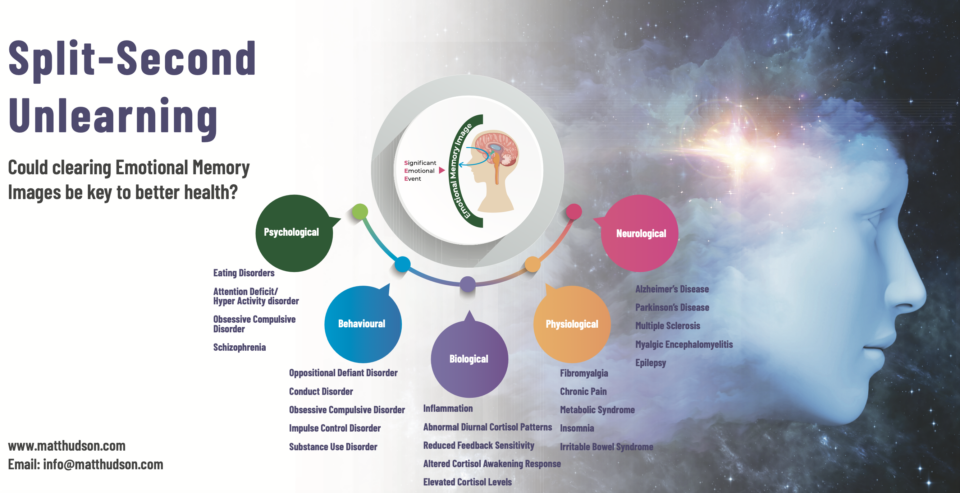
First, Emotional Memory Images (EMIs) are proposed to originate during a first-time emotionally overwhelming learning event. During this moment, the individual experiences a rapid freeze response that interrupts normal processing and integration of experience. The resulting EMI becomes stored outside conscious awareness and remains inaccessible to deliberate recall.
Second, the EMI functions as an amnesic and anachronistic source of information. Although the original event may no longer be consciously remembered, the EMI continues to operate in the present as if the threat remains current. Consequently, the individual responds not to present reality, but to an outdated prediction generated by a past experience that has become disconnected from time.
Third, activation occurs automatically whenever the individual encounters environmental cues that resemble aspects of the original overwhelming event. These cues may be visual, auditory, relational, situational, or contextual. Once activated, the EMI triggers the same psychophysiological freeze response associated with the original experience, often without the individual’s awareness that a past memory pattern has been engaged.
The Hudson Method proposes that these EMIs are maintained within the mind’s eye as non-conscious informational imprints. By activating the EMI, observing its manifestation through behavioural and ocular markers, and disrupting its connection to the individual’s visual-attentional system, coherence can be restored and the maladaptive stress response resolved.
Case Study: A 30-Year Chronic Pain Response
A 51-year-old man presented with trigeminal neuralgia that had persisted intermittently for more than 30 years. During discussion of the onset of his symptoms, he described a childhood bicycle accident and recalled his father arriving at the hospital. As he recounted this moment, his eyes fixated on a specific point in space, his posture shifted, his breathing changed, and his facial expression became blank for a split second.
When guided back to this moment, the same response immediately reappeared, suggesting activation of an Emotional Memory Image (EMI). Rather than analysing the memory itself, attention was directed toward disrupting the client’s fixation on the EMI. As the connection between the EMI and the client’s visual-attentional system was interrupted, his breathing deepened, his facial colour returned, and the physiological stress response resolved.
The client subsequently reported that the vivid image of his father entering the hospital room had faded and that the chronic pain he had experienced for three decades did not return. From a Hudson Method perspective, the intervention did not change the historical event itself. Instead, it altered the client’s relationship with the EMI that had continued to trigger an anachronistic freeze response long after the original event had passed.
What Are Emotional Memory Images and Where Are They Stored?
Traditional neuroscience confines memory to brain regions such as the hippocampus and amygdala. Source context indicates that non-neural cells including astrocytes and glial cells can maintain memory patterns through calcium signaling and gliotransmitter release independent of synaptic activity. These findings challenge conventional assumptions about where information resides within the body.
Emotional Memory Images (EMIs) are proposed to be non-conscious informational imprints that exist beyond conventional neural memory systems. Building upon Bruce Lipton’s proposition that cell membranes act as information-processing interfaces, the Hudson Method suggests that the collective electromagnetic and informational activity generated by approximately 72 trillion cells may create a coherent extracorporeal information field surrounding the individual.
Within this framework, EMIs are not necessarily stored within neurons, synapses, or even individual cells, but may exist as stable informational patterns within the human field itself. This perspective aligns conceptually with Donald Forsdyke’s proposal that memory may be accessed from an extracorporeal information space and Rupert Sheldrake’s theory of morphic fields, which suggests that information can persist beyond physical structures and influence biological systems through resonance.
The Hudson Method proposes that these EMI patterns typically reside within peripersonal space, often observable through involuntary eye-fixation patterns occurring within arm’s length of the individual. When activated by present-day cues, these informational imprints appear to trigger rapid autonomic responses, including orienting reactions, freeze responses, altered breathing patterns, muscle tension, and emotional distress, despite the absence of conscious recollection.
Rather than viewing the brain as the sole repository of emotional memory, the Hudson Method explores the possibility that the brain functions partly as a receiver and interpreter of information arising from a wider organism-generated field. In this model, Emotional Memory Images represent localized informational disturbances within that field, and Split-Second Unlearning facilitates their rapid disruption and reintegration, restoring coherence across the brain-heart-body system.
The Hudson Method
There is also a proposal that memory maybe stored within cellular structures throughout the body, not limited to neural networks in the hippocampus or amygdala. Recent findings from NYU suggest that astrocytes actively participate in processing and retaining experiential data. Such patterns may persist beyond the lifespan of individual neurons.
Memory storage appears distributed across multiple tissue types rather than centralised in neural clusters alone. Cellular memory mechanisms, as revealed by calcium imaging, demonstrate that non-neural structures respond to stimuli with lasting changes. This raises the question: what are emotional memory images and how do they relate to trauma? These responses suggest information processing occurs at the tissue level.
Recipients of transplanted organs sometimes report shifts in personality traits or preferences following surgery. Such observations raise questions about how identity and self relate to cellular patterns carried within donated tissues. The implications extend beyond standard models of brain-based consciousness.
The Hudson Method and Non-Local Memory Access
The Hudson Method proposes that Emotional Memory Images (EMIs) are non-conscious informational imprints associated with unresolved stress responses. Rather than seeking memories through conscious recall, the practitioner observes the client’s spontaneous physiological and behavioural responses as an EMI becomes activated in real time.
The process begins with the client bringing attention to a current symptom, challenge, or triggering situation. As the associated EMI activates, subtle but observable markers may emerge, including changes in eye fixation, gaze direction, blinking, facial expression, breathing, posture, vocal tone, or momentary pauses in awareness. These responses provide evidence that the individual is accessing an established stress pattern operating outside conscious awareness.
The practitioner does not interpret the content of the memory or require detailed narrative disclosure. Instead, attention is directed toward observing how the client relates to the activated EMI within their perceptual field. Particular emphasis is placed on involuntary eye movements and fixation patterns, which may indicate the location of the EMI within the client’s subjective experience.
Once activation is established, the practitioner facilitates disruption of the connection between the EMI and the client’s visual-attentional system. By interrupting the established eye fixation pattern associated with the stress response, the automatic link between the EMI and the physiological freeze response is weakened or dissolved. As this occurs, clients frequently demonstrate immediate signs of autonomic regulation, including altered breathing, muscular relaxation, emotional release, changes in facial expression, and restoration of behavioural flexibility.
The Hudson Method therefore focuses not on analysing memories, challenging beliefs, or processing narratives, but on identifying and disrupting the non-conscious perceptual mechanisms that maintain maladaptive stress responses. The objective is the restoration of coherence within the brain–body system through the resolution of the client’s relationship with the EMI rather than through prolonged cognitive intervention.
Can Epigenetic Signals Explain Memory Outside DNA?

Epigenetic signaling mechanisms allow cells to store experiential information through methylation patterns and histone modifications that extend beyond DNA sequence, providing a biological framework for cellular memory independent of neural structures. These processes enable non-neural cells throughout the body to retain traces of environmental encounters without requiring neurons or brain structures.
Bruce Lipton’s research demonstrates that membrane receptor proteins respond to environmental signals by altering gene expression without changing DNA structure, suggesting cells outside the brain can maintain memory through these same epigenetic pathways. This perspective challenges conventional boundaries between brain and body when considering where memory actually resides.
Consciousness may operate through distributed networks rather than centralised control alone. The distinction between neural and cellular memory becomes less rigid when examining how signal transduction operates across different tissue types. A recent Nature publication explores how DNA methylation serves as an epigenetic mark of cellular memory, reinforcing the concept of distributed information storage. Such findings invite reconsideration of how identity persists through various biological systems.
Cellular information storage operates continuously across multiple scales. This distributed architecture suggests memory emerges from coordinated activity rather than isolated locations within any single organ.
Bruce Lipton’s Biology of Belief Framework
Bruce Lipton’s Biology of Belief framework proposes that cell membrane receptors function as information processing units, allowing non-neural cells to store and respond to environmental signals through signal transduction pathways. These receptors detect various inputs including stress hormones and electromagnetic fields that influence cellular behavior.
The mechanism unfolds through several stages. Cell receptors first detect environmental signals, then the signal reaches the nucleus and modifies gene expression without DNA alteration. Modified expression patterns persist across cell divisions creating cellular memory that can be accessed and changed through conscious intention affecting receptor binding.
Belief change work provides one illustration of this process. A perception shift can produce measurable cortisol level shifts within twenty minutes, demonstrating rapid cellular memory modification without requiring structural brain changes. The body responds to meaning as readily as it responds to chemical messengers.
This framework positions the cell membrane as an active participant in consciousness rather than passive boundary. Such a view aligns with broader inquiries into how memory might exist within an informational field extending beyond traditional anatomical limits.
How Does Psych-K Reprogram Field-Based Beliefs?
Psych-K utilizes whole-brain integration techniques to reprogram subconscious beliefs stored as electromagnetic field patterns across cellular networks rather than modifying individual neuron connections. This approach recognizes that memory extends beyond neural pathways into non-neural structures throughout the body. Practitioners understand that consciousness operates through field-based information rather than isolated cellular mechanisms alone.
The protocol begins with identification of limiting beliefs through muscle testing. A practitioner might present the statement I am not safe and observe physical responses indicating weakness or resistance. This method reveals subconscious patterns stored within the information field that influence behavior and emotional states. The testing process provides direct access to embodied memory systems.
Next, participants create new belief statements aligned with desired outcomes and adopt a whole-brain posture with crossed arms and legs. They hold this position for 30 to 60 seconds while focusing on the new affirmation. This posture facilitates integration across both hemispheres of the brain while allowing field patterns to reorganize. The technique creates conditions for cellular memory to shift toward supportive configurations.
Verification occurs through repeated muscle testing that demonstrates strength responses to the new belief statement. Changes typically stabilize within minutes following the intervention. Follow-up assessment at 24 hours and 7 days confirms the integration has taken hold within the information field. This structured approach addresses the mind-body connection at the level of consciousness itself.
Could Morphic Resonance Store Human Memory Patterns?
Traditional models require physical storage in brain tissue, but Sheldrake’s framework suggests memory operates through non-local fields that resonate across time and space, allowing access to learned behaviors and experiences without direct cellular encoding. This perspective challenges conventional neuroscience by proposing that information can persist independently of neurons and synapses.
Morphic resonance theory, developed by Rupert Sheldrake, proposes that memory patterns exist as morphic fields that can be accessed by subsequent organisms without physical transmission through neural pathways. The theory implies that habits, skills, and learned responses become available to future generations through these invisible structures rather than through direct genetic inheritance alone.
Under this model, the brain functions more as a receiver than a storage device. Information flows through electromagnetic and morphogenetic channels that connect individual organisms to species-wide patterns accumulated over time. Such a mechanism would explain phenomena that resist purely cellular explanations, including instinctive behaviors that appear without prior training.
Memory would therefore extend beyond the boundaries of any single body. Organisms could draw upon collective reservoirs of experience, reducing reliance on physical structures within the hippocampus or prefrontal cortex. This view invites reconsideration of how consciousness and identity might persist across different physical forms.
Donald Forsdyke’s Information Field Theories
Donald Forsdyke’s information field theories propose that genetic and behavioral information exists in electromagnetic field structures surrounding organisms, creating accessible memory banks independent of DNA or neural storage. These fields operate as external repositories that cells can consult without direct molecular contact.
The mechanism involves several coordinated processes. Field patterns encode sequence information through electromagnetic resonance. Cells tune into relevant field frequencies through receptor proteins. Information transfer occurs without physical molecular exchange. Memory persists as stable field configurations after the source organism dies.
Consider identical twins separated at birth exhibiting synchronized behavioral patterns without shared environmental exposure, suggesting field-based information transfer. Such cases indicate that certain preferences and tendencies may arise from shared field structures rather than from common upbringing or genetic expression alone.
This framework carries implications for understanding organ transplantation and recipient identity. If memory patterns reside partly in surrounding fields, then tissue transfer might carry subtle informational influences. Recipients sometimes report changes in preferences or temperament that cannot be attributed solely to surgical recovery or medication effects.
What Evidence Supports Memory as a Non-Local Field Phenomenon?
Research from transplant recipients demonstrates memory transfer phenomena that cannot be explained by neural pathway reconfiguration, providing empirical support for non-local memory storage mechanisms. These cases challenge conventional views of memory as confined to neurons. Instead, they suggest information patterns persist independently of physical brain structures.
Organ transplant studies reveal recipients acquiring donor preferences for specific foods, music selections, and personality traits within days following surgery. Neural connections between donor tissues and recipient brain remain impossible in these scenarios. Such rapid acquisition of foreign characteristics points toward information field transfer rather than conventional cellular memory mechanisms.
Heart transplant recipients have reported sudden cravings matching documented donor preferences, including chicken nuggets and Snickers bars from a deceased individual. The University of Arizona transplant research program has documented these instances where new tastes emerge without prior exposure or psychological suggestion. These observations support theories of non-local storage distributed across cellular systems beyond the nervous system, findings that are further corroborated by research published in MDPI’s Sci, which explores documented personality changes associated with organ transplants.
Phantom limb phenomena provide additional evidence that amputees continue to experience sensations in removed body parts. These perceptions arise from field memory patterns rather than from active neural pathways. The persistence of sensory experience after physical removal suggests that memory resides in information structures extending beyond the boundaries of biological tissue.
Rubber hand illusion experiments demonstrate how body schema extends into non-biological objects under controlled conditions. Participants report tactile sensations in artificial limbs when visual and tactile inputs align. This research reveals the plasticity of self representation, supporting the concept of memory as an embodied field phenomenon rather than localized neural encoding alone.
Human Consciousness Studies 2024 – Key Survey Findings
Human Consciousness Studies 2024 – Key Survey Findings

Dualism Perception Survey: Participant Responses
Dualism Demographics: Dualism Levels (Lower = Less Dualistic)
The Human Consciousness Studies 2024 survey presents striking uniformity in responses. Every participant category reflects 100% dualistic views. In the Mary Experiment, all respondents agreed that consciousness is physical. Experience registers in the brain. Yet they also affirmed that consciousness is not physical when considering the Zombie Experiment. Such outcomes suggest a strong inclination toward dualistic perception among participants.
The data further reveals that neurotypical people and females both maintain a 100% dualism rate. This uniform stance across survey metrics underscores a widespread acceptance of both physical and non-physical interpretations of consciousness. It provides insights into how dualistic theories resonate across different demographics.
How Might Quantum Biology Enable Extra-Cellular Memory?
Quantum biology mechanisms involve coherent states in cellular water. Electromagnetic field interactions may enable memory storage outside neural structures. These processes suggest that information could persist beyond traditional synaptic connections. Such mechanisms challenge conventional views of how memory forms within the brain and body.
Cellular water maintains coherent domains. These allow information encoding through electromagnetic patterns across extended spatial regions. These domains create stable environments. Molecular arrangements can hold data in organized configurations. Research suggests such structures may support information retention that extends beyond individual cells.
Calcium ion oscillations create quantum coherent states in living tissues. These fluctuations generate synchronized activity across cellular networks. Quantum coherent states in calcium signaling may contribute to memory formation beyond single neurons.
Microtubule structures process information through quantum computation. These protein assemblies support complex pattern recognition and data manipulation. Field memory persists through quantum entanglement across cellular networks, allowing coordinated activity between distant components of the body.
Does the Human Information Field Interact with Collective Memory?
The human information field interfaces with collective morphic fields. Individual cellular electromagnetic fields contribute to larger morphic field structures. This process creates pathways for shared informational exchange across populations.
Access to these collective patterns occurs through resonance tuning. Cells and neurons align their calcium signaling frequencies to match existing field structures. Such alignment allows individuals to receive information without conventional learning pathways.
Collective memory manifests through intuitive knowing or spontaneous skill acquisition. Organ transplant recipients sometimes report personality shifts that mirror donor characteristics. These experiences suggest non-neural memory storage extends beyond traditional brain regions like the hippocampus or amygdala.
Field strength increases with focused attention from multiple individuals. When several people concentrate on similar problems simultaneously, the resulting amplification strengthens access to stored patterns. Historical cases demonstrate this principle when unrelated individuals develop identical innovations within short timeframes.
What Experimental Designs Could Test Field Memory Hypotheses?
Rigorous experimental designs require protocols that eliminate conventional neural pathway explanations. These approaches must isolate variables that standard brain-based models cannot readily account for when examining how memory, perception, and behavioural responses might persist beyond cellular structures alone.
Researchers must establish baseline measurements before introducing experimental conditions. Multiple layers of verification become essential when testing whether non-neural pathways could contribute to the storage, transmission, or activation of memory traces between individuals or across spatially separated environments.
Ethical oversight committees must review each protocol to ensure participant safety. Documentation standards require independent verification at every stage of measurement to maintain scientific integrity when exploring unconventional hypotheses concerning consciousness, memory, and identity.
One emerging example of this approach is the application of the Hudson Method within the digital platform MindReset. Built upon the principles of Split-Second Unlearning and Emotional Memory Images (EMIs), MindReset utilizes eye-tracking technology to identify and interrupt non-conscious stress patterns associated with maladaptive emotional responses. The platform has attracted international interest and was nominated within the Digital Public Health Conference (DPH) innovation programme, reflecting growing recognition of the potential for scalable, technology-assisted approaches to emotional regulation and mental wellbeing.
Double-blind transplant memory studies could track recipient preference changes following organ transplantation. Independent researchers would verify donor histories through separate channels, while standardized preference inventories would document shifts that align with donor characteristics rather than surgical, pharmacological, or psychological explanations alone.
Electromagnetic shielding experiments could isolate participants within Faraday enclosures to evaluate whether information transfer depends upon electromagnetic interactions. Pre- and post-testing protocols would compare behavioural, perceptual, and physiological responses between shielded and unshielded groups.
Additional investigations might examine whether activation of Emotional Memory Images produces measurable changes in eye-fixation patterns, autonomic responses, and behavioural outcomes. Such studies could compare conventional cognitive interventions with EMI-focused approaches to determine whether rapid restoration of coherence is associated with measurable changes in attention, physiology, and symptom reduction.
Ultimately, the challenge is not merely to prove or disprove field-memory hypotheses, but to develop experimental frameworks capable of distinguishing between neural, cellular, and potentially extracorporeal explanations for human memory, behaviour, and consciousness.
A Final Thought to Take Forward.
If Lipton moved biology beyond DNA and into the membrane, and Sheldrake moved memory beyond the cell and into morphic fields, the Hudson Method asks whether emotional trauma may represent a specific class of informational imprint existing within the human information field itself. From this perspective, Psyche-K and the Hudson Method may be exploring different layers of the same phenomenon. Psyche-K appears to work at the level of subconscious beliefs encoded within the field, while Split-Second Unlearning seeks to identify and dissolve the originating EMI that organised those beliefs in the first place. The question becomes not whether beliefs create biology, but what creates the beliefs.